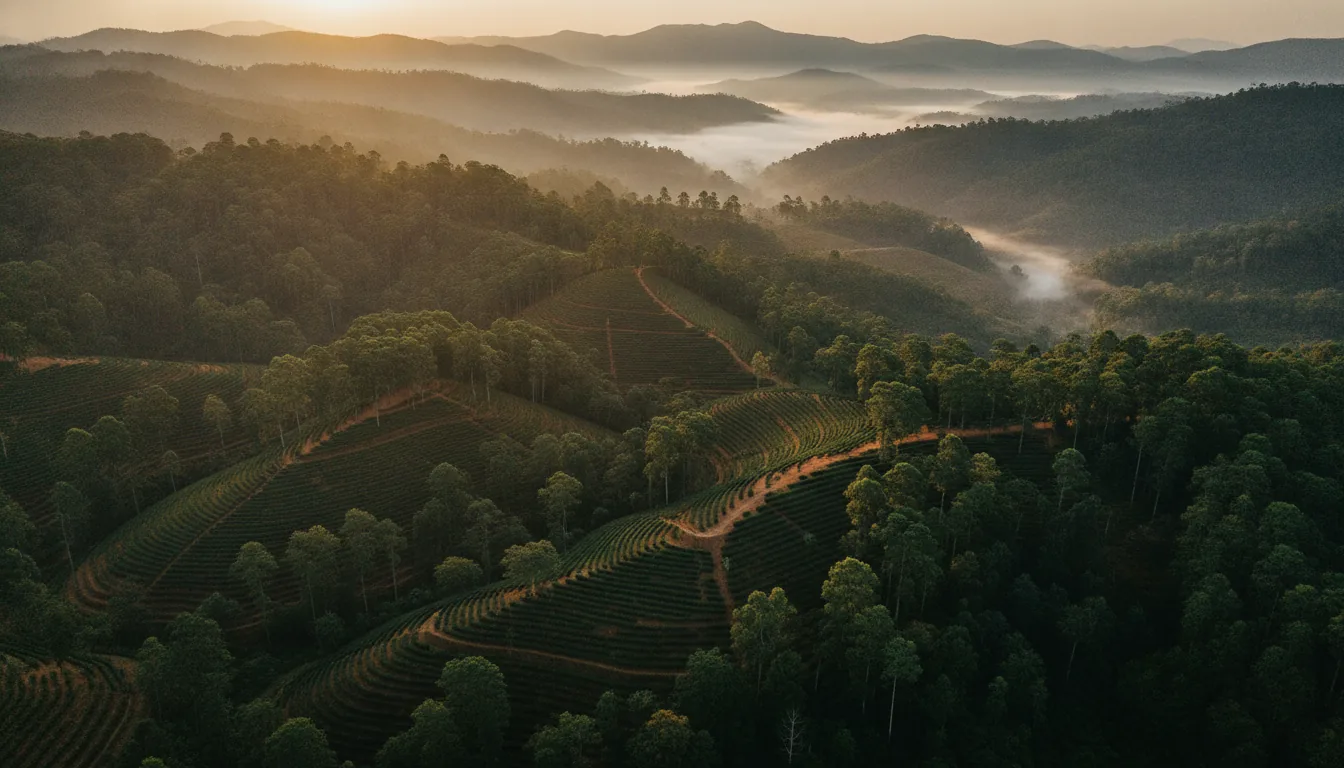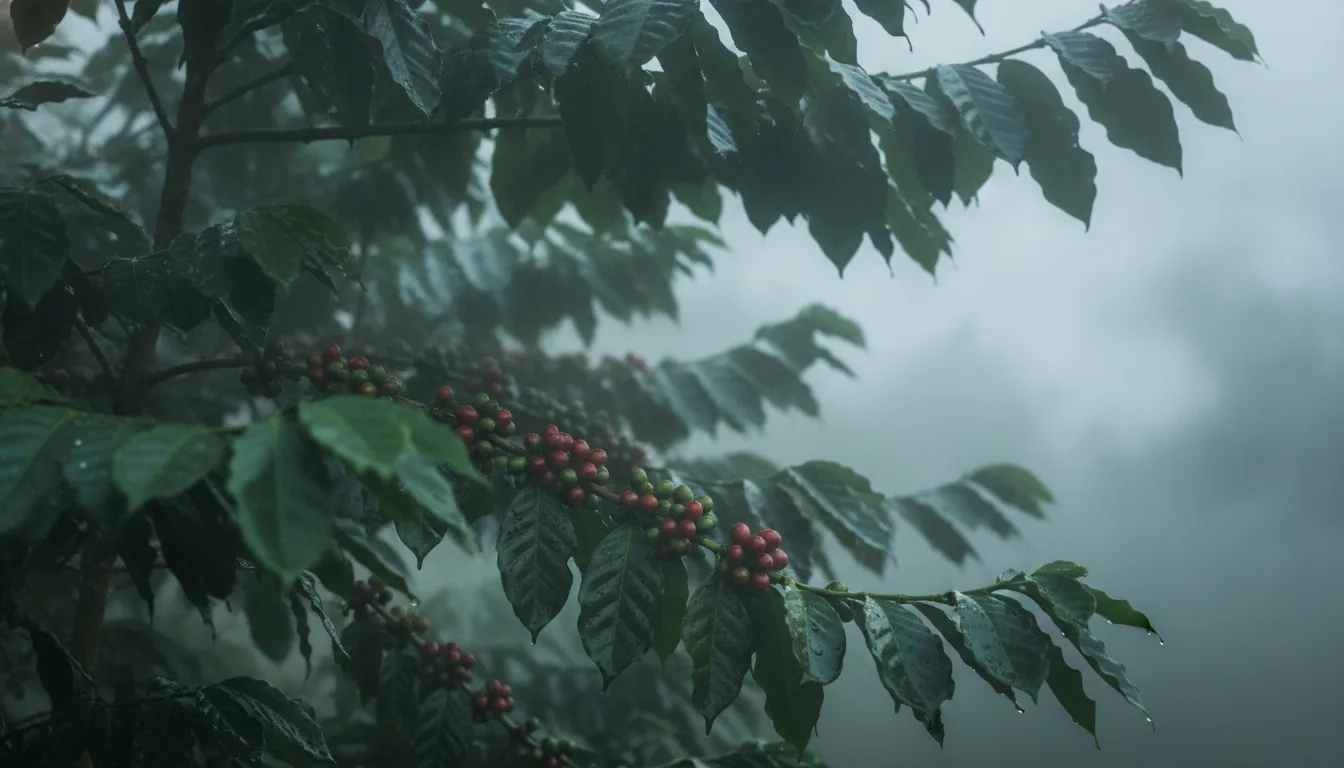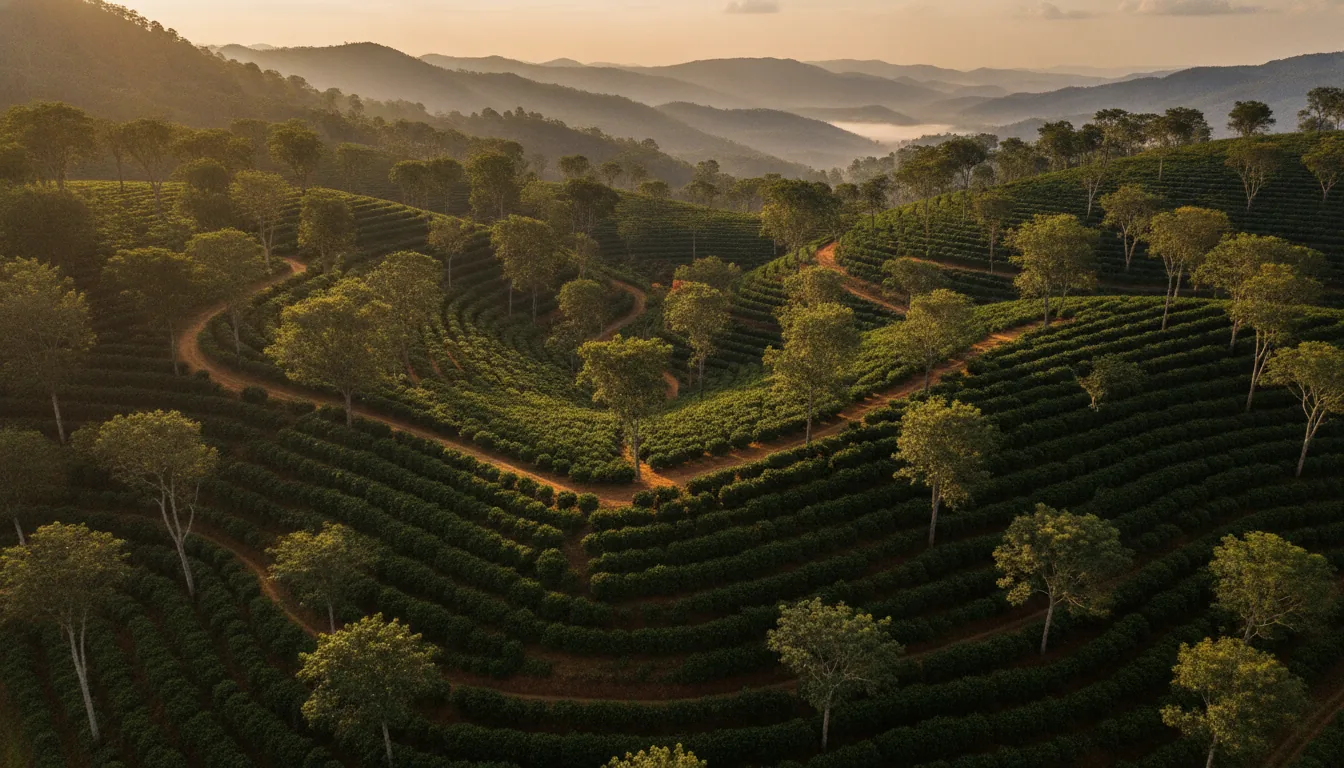

What does “coffee estate” actually mean
Under the Coffee Act, 1942, an estate means an area administered as one unit which contains land planted with coffee plants. The definition is about administration, not about size or ownership structure. It says nothing about who holds title inside that unit.
That is one of two meanings you will meet, and they come from different worlds. The specialty coffee trade uses the same word to describe processing capability rather than administration. A trade glossary defines a coffee estate as a farm that has its own processing facility, a wet mill, and notes that a finca does not necessarily have a mill at all. In the strictest trade sense an coffee estate would have both a wet mill and a dry mill. A specialty explainer written for Indian coffee puts scale next to it, describing a single owned or family-managed agricultural unit, typically 20 to 500 hectares and above, that produces coffee and controls at least part of its own processing, concentrated in Chikmagalur, Sakleshpur, Coorg, the Biligiri Hills and the Shevaroy Hills between 800 and 1650 metres.
So a buyer searching to own land keeps meeting definitions written for people who drink coffee. Neither meaning describes ownership structure. One describes how the land is administered, the other describes what happens to the cherry after picking.
There is a third definition circulating online that a buyer in India should set aside deliberately. It sets a floor of not less than two acres in aggregate under the same ownership on which coffee is grown, or an average production of not less than twenty thousand kilograms of cherry a year over three years. That text comes from the Kenya Coffee General Regulations, 2018. It has no application in India, and Indian statute sets no minimum acreage for the word estate.
The Indian statute does attach a duty, though, and it is the part almost nobody mentions. Section 14(1) of the Coffee Act, 1942 says every owner of land planted with coffee plants shall, before the expiration of one month from the date on which they first became owner, apply to the registering officer to be registered as an owner. Registration with the Coffee Board of India is part of owning coffee land, not an optional extra, and district portals list grower registration as a routine online service. In Indian law, then, estate is closer to a registration term than a marketing one, which is why it sits so comfortably beside the other word you will see on the same listings.
Table of Contents
Is a coffee plantation different from a coffee estate
In Karnataka land law, neither word is the operative one. The Karnataka Land Reforms Act, 1961 defines “plantation crops” as cardamom, coffee, pepper, rubber and tea. The statute recognises the crop, not the label a listing puts above the photographs.
In practice the two words divide up like this. Plantation usually describes what is growing. Estate usually describes how the growing is administered. The same hillside can be called both without either description being untrue, which is exactly why four listings can look identical and read differently.
Neither word appears as a category on the land record. The record deals in survey numbers, extent, classification and the name of the holder. A seller choosing between plantation and estate is choosing a register of language, not a legal status.
It also helps to know that a coffee plantation is rarely only coffee. The Coffee Board of India states that India is the only country that grows all of its coffee under shade, under a two-tier canopy with roughly fifty different shade tree types, with pepper and cardamom recurring as intercrops across the growing regions alongside arecanut, banana, orange and vanilla. Multi-crop land is the norm here, not the exception. The word that changes the picture most is not plantation or estate. It is raw.
What is raw plantation land, and what does “raw” actually signal
“Raw” has no definition in Indian law. On a listing it usually signals land that carries plantation crops but has no service wrapped around it, which means farming, security, access, water, fencing and upkeep all sit with whoever buys it.
Read practically, the word raises a set of questions the listing will not answer on its own. Who prunes and harvests, and who pays and supervises that labour. Who is on the land during the months you are not. Whether there is an approach road that holds through the monsoon. Whether there is a water source and a fence, or a plan for both. None of that is contained in the word raw. All of it is answerable by asking.
Raw plantation land suits a buyer who intends to farm it themselves or arrange their own management, and there is nothing thin about that choice. It is simply a different undertaking from land that arrives with a service attached. That comparison deserves its own space rather than a paragraph here, so if it is the question you are actually holding, read what changes between a managed estate and raw plantation land.
Raw or serviced, the same land will usually also be described with a third word, and it is the widest of the four.
What does “agricultural farmland” mean on a listing
The Karnataka Land Reforms Act, 1961 defines land as agricultural land, that is land used or capable of being used for agricultural purposes, and it includes horticultural land, forest land, garden land, pasture land, plantation and tope.
House-sites and land used exclusively for non-agricultural purposes are the exclusions. Read that list again and the confusion resolves itself. A working coffee estate, a pepper-heavy plantation and a bare field with nothing on it can all be described as agricultural land, truthfully, at the same time. The category was drawn wide on purpose. Farmland is everyday English for the same idea and carries no separate statutory meaning of its own, which is why it can be attached to almost anything green.
Timber is worth a line here, because it sits oddly in that definition and a careful reader will notice. The same Act defines agriculture to include aquaculture, horticulture, the raising of crops, grass or garden produce, dairy farming, poultry farming, breeding of livestock and grazing, but not the cutting of wood only. Standing timber on a working estate sits comfortably inside the agricultural picture. A holding whose only activity is felling wood does not.
The width of the category is also why the word tells you nothing about conditions. Coffee Board region data puts Chikmagalur between 700 and 1200 metres above sea level with annual rainfall from 1000 to 4500 millimetres, and the Bababudangiris between 1000 and 1500 metres with 1750 to 2200 millimetres. Two holdings, both accurately called agricultural farmland, can sit in completely different growing conditions. The fourth word, and the one doing the most work in current listings, narrows things differently again.
What is “managed farmland”, and is a managed coffee estate the same thing
Managed farmland names an arrangement, not a kind of land. It describes agricultural land an owner holds while someone else farms and maintains it. The phrase carries no statutory definition, so it tells you nothing until you read the service agreement.
This is where two listings using identical words can mean genuinely different things. The scope varies from seller to seller, and the only reliable way through it is the agreement rather than the adjective. What is farmed and by whom. Who holds responsibility for security. What happens to roads, fencing and water, and who pays for them. Who the owner speaks to when something needs attention. What is committed in writing and what is stated as intention.
The honest distinction, put plainly, is between a piece of land registered in your own name that arrives with a full service around it, and an unmanaged piece of land where all of that upkeep is yours. Acres Community sells a half-acre of managed coffee estate, registered in the buyer’s own name with their own land record. Half-acre is the minimum and larger parcels are available. Managed, in our case, covers farming and crop care, security, roads, fencing and water, and a dedicated relationship manager for each owner, across an estate worked as one unit for coffee, pepper and timber. For the full definition, including what each of those four parts involves, read what managed actually covers on a working estate.
Once the service question is settled, the words describing the unit itself are the next thing to translate.
What do “plot”, “per-acre” and “fractional” mean in a listing
All three describe the size of the unit being sold and how it was carved out of a larger holding. None describes the crop, the service or your title. What they leave open is what the record will show in your name.
Land in coffee country is sold in several honest shapes. Some sellers offer the entire administered holding. Some offer a piece of it recorded separately in the buyer’s own name. Some offer a share in a holding that stays recorded as one. Each of these is a real way to own land and each gives the buyer something different, so the vocabulary is worth translating rather than trusting.
Translated, it becomes a records question rather than a language question. Will the extent I am buying be recorded separately in my name, or will I hold a share in something recorded in another name. That is answerable from documents before any commitment, and the answer matters far more than whether the listing said plot, parcel or unit. If the size of the unit is the part you are still weighing, choosing the size of what you own works through what different extents actually mean to live with.
One more unit word turns up often enough to be worth defining before the summary.
What does “whole estate” mean when a listing uses it
Whole estate means the entire administered unit is being offered rather than a portion of it. It describes what is on the table, not the quality of the land or the strength of the title attached to it.
It is one more unit description a buyer will meet while reading listings, and it carries a scale assumption worth correcting, because most people hear it and picture something vast. Kodagu alone has roughly 106,921 hectares under coffee across about 43,961 holdings, close to 44 per cent of Karnataka’s coffee area, and most of that area is held by small growers with less than ten hectares each. A whole estate in Indian coffee country is very often a modest family holding rather than a plantation of the imagination.
Set that against the trade definition earlier, where an estate is described as typically 20 to 500 hectares and above, and the gap between the word and the ground becomes visible. Both descriptions are in circulation. Only one of them describes the district you are likely to be buying in. Which brings the page to the question it has been building towards.
Which of these words carry legal weight, and which are marketing
“Plantation crops” and “agricultural land” are defined in the Karnataka Land Reforms Act, 1961. “Estate” is defined in the Coffee Act, 1942 for registration purposes. “Raw”, “managed”, “premium”, “developed” and “farmland” as a sales word carry no statutory definition in India.
Word by word, so you can check a listing against it:
- Estate | defined in the Coffee Act, 1942 as an area administered as one unit containing land planted with coffee plants, and attached to a registration duty.
- Plantation | not a land category in Karnataka law. The statute defines “plantation crops” as cardamom, coffee, pepper, rubber and tea.
- Agricultural land | defined in the Karnataka Land Reforms Act, 1961 as land used or capable of being used for agricultural purposes, including plantation, garden land, forest land, pasture land and tope.
- Farmland | everyday English for agricultural land, with no separate statutory meaning of its own.
- Raw | no statutory definition. A seller’s description of land carrying crops with no service around it.
- Managed | no statutory definition. A description of a service arrangement, which is defined by its agreement rather than by the word.
- Premium and developed | no statutory definition. Descriptions of condition or amenity, meaning only what the seller means by them.
- Plot, per-acre and fractional | descriptions of unit size and how the unit was carved out, not of legal standing.
- Whole estate | a description of the entire administered unit being offered, not a category on the record.
None of the descriptive words is dishonest. Condition, service and unit size are things a buyer genuinely wants to know, and sellers are right to describe them. They are simply descriptions rather than evidence, and they should be read as an invitation to ask rather than as an answer. What actually separates one holding from another is not the adjective in the headline but the things that make one estate worth more than another.
So what should you actually ask when a listing uses one of these words
Translate every word into three questions. What is growing on this land. What does the record say about it. What exactly is being transferred into my name. Any listing word that cannot answer one of those three is decoration.
The first question is answerable on a visit and in the crop history. The second is answerable from the documents, and it is the one that survives every change of vocabulary, because the record does not use listing language. The third is the one buyers most often assume rather than confirm, and it is worth putting into a sentence and asking out loud.
Held together, those three turn a confusing set of words back into a straightforward conversation, and they work on any listing regardless of which adjective it opened with.
Frequently asked questions
What is a coffee estate?
In Indian law, an estate is an area administered as one unit which contains land planted with coffee plants, under the Coffee Act, 1942. In coffee trade usage the same word describes a farm that controls its own processing. Neither meaning describes how ownership is held.
What is a coffee plantation?
A coffee plantation is land under coffee cultivation. Karnataka law does not treat plantation as a land category, but it does define “plantation crops” as cardamom, coffee, pepper, rubber and tea. In listings, plantation usually describes the crop while estate describes the administration.
What is the difference between agricultural land and farmland?
Agricultural land is the legal term, defined in the Karnataka Land Reforms Act, 1961 to include plantation, horticultural land, garden land, forest land, pasture land and tope. Farmland is the everyday word for the same thing. Only the first has a statutory definition behind it.
Is there a coffee estate in Karnataka?
Yes. The Coffee Board names Chikmagalur, Coorg, the Bababudangiris and Manjarabad among the state’s growing regions, and Chikmagalur alone sits between 700 and 1200 metres above sea level. Kodagu carries roughly 43,961 separate coffee holdings, most of them small.
Are there coffee plantations in India?
Yes, concentrated in the southern hills, with estates named across Chikmagalur, Sakleshpur, Coorg, the Biligiri Hills and the Shevaroy Hills between 800 and 1650 metres. The Coffee Board notes that India is the only country growing all of its coffee under shade.
Does the word a listing uses tell you what you will actually own?
No. Estate, plantation, farmland and raw land describe crop, administration and condition, not title. What you will own is defined by the land record and the transfer documents, and those use none of this vocabulary.
Where this leaves you
Vocabulary is the first filter, not the last. Once the words stop doing the confusing, the questions that follow are about place and paperwork. Which belt the land sits in, what the elevation and rainfall do to the crop, and what the documents show about the extent going into your name. The place question is a good next one, and takes it apart properly.
Acres Community’s live project, Euphora, sits in the Belur and Sakleshpur belt, and what is sold there is a half-acre of managed coffee estate registered in the owner’s own name. If you would like to see what is currently available, or to enquire for current pricing, get in touch and we will walk you through the records alongside the land. While the world visits, you belong.