
Every page written about Chikmagalur opens the same way: a saint, seven beans, a hill. Resorts tell it, roasters tell it, travel blogs tell it, and almost none of them say which parts of that story sit in folklore and which parts sit in the record. If you are considering land in coffee country, that difference matters more than the romance does.
Chikmagalur is where coffee cultivation in India began. Tradition places the first plants on the hills now called Baba Budangiri in 1670, and the district administration still records it that way. Commercial planting is younger and far better documented: the first substantial British plantations date from the 1820s, and the district has grown coffee without a break since.
Table of Contents
How coffee first came to Chikmagalur
By tradition, a Sufi ascetic named Baba Budan carried seven coffee beans home from Yemen in the seventeenth century and planted them in the Chandragiri hills. The district administration dates that first planting to 1670 A.D. It is tradition, not archive.
The story is specific enough to be worth repeating carefully. Baba Budan is remembered as a saint who came back from pilgrimage with seven beans hidden on him, since carrying fertile coffee out of Arabia was forbidden at the time. He planted them in the Chandragiri hills. That range is now called Baba Budangiri, after him.
Where the sources part company is on the detail. The Chikkamagaluru district administration states that the first coffee in the country was grown at Baba Budan Giri in 1670 A.D. National accounts of Indian coffee production put the seven beans at the beginning of the seventeenth century and name the port of Mokha in Yemen. Most of the resort and roaster pages that fill this search result say Mecca instead, and the late 1600s.
No document settles it. What every version agrees on is the place, the number seven, and the fact that Indian coffee starts here. Treat 1670 as the traditional date, held by the district itself, and treat the rest as story. The record picks up two centuries later, when coffee in Chikmagalur stopped being one man’s garden and became a district industry.
When Chikmagalur became a commercial coffee district
From the 1820s. The first substantial British plantations were established near Baba Budan Giri and Chandragiri, by planters including Cannon and J.H. Jolly of Parry and Co. The district administration records Europeans pioneering large scale coffee plantations more than 150 years back.
Cultivation had already spread beyond Baba Budan’s original garden by around 1820, and European planting activity picked up through the 1840s. The sequence matters: a hill garden first, then a slow local spread, then organised estates at commercial scale. Nothing about it happened in a single decade.
The district carried a different name through all of it. Chikmagalur was Kadur district until 1947. The name it uses now, spelled Chikkamagaluru in official records, comes from the Kannada words chikka, magala and ooru, meaning younger daughter’s town, said to have been land given as dowry to a chief’s younger daughter.
Two centuries of continuous planting produce something a new growing region cannot manufacture: known varieties, tested shade systems, and soils farmed for coffee long enough that they behave predictably. That starts with what is actually in the ground here.
Whether Chikmagalur coffee is Arabica or Robusta
Both, in close to equal weight. Coffee Board of India figures for Chikmagalur give Arabica 37,000 hectares producing 29,000 metric tonnes, and Robusta 23,000 hectares producing 30,000 metric tonnes. Arabica holds the higher ground, Robusta the lower and warmer pockets.
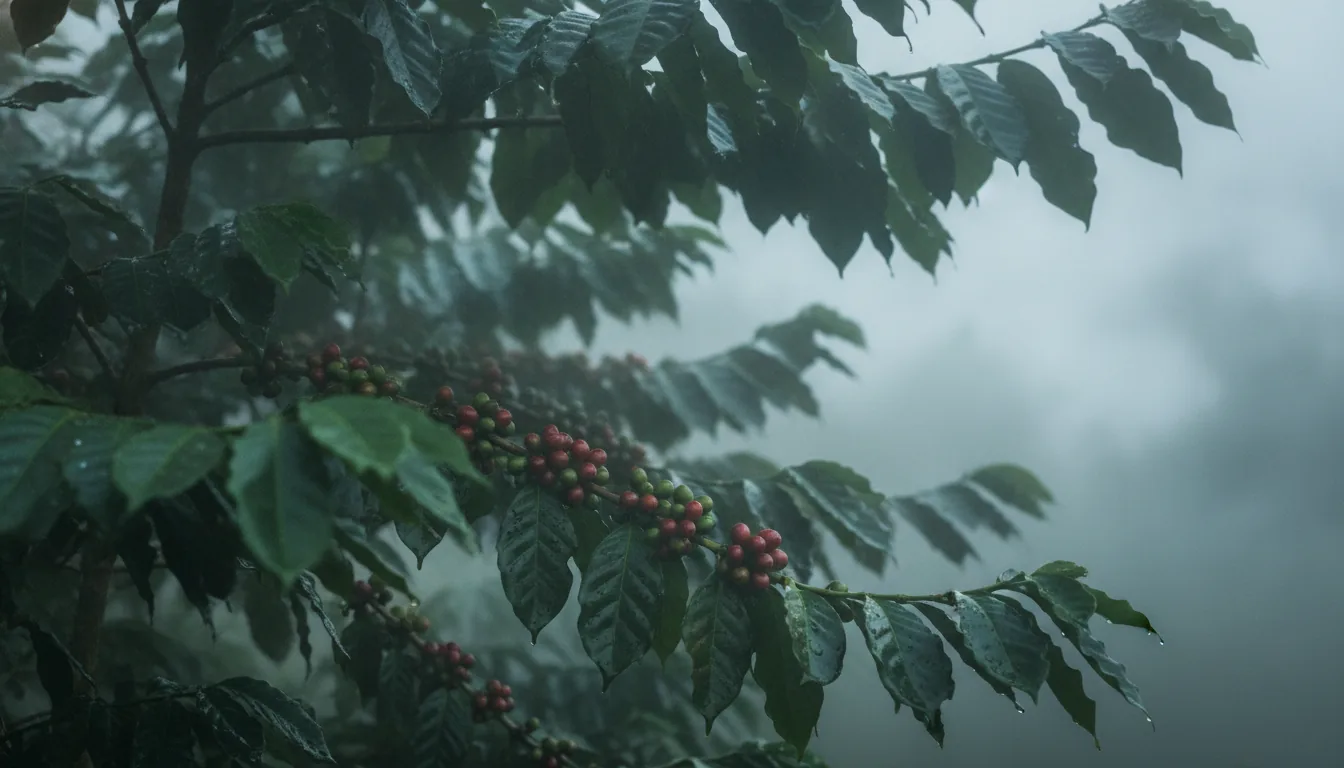
The named varieties are more useful than the label. The Coffee Board lists S.795, Sln.5B, Sln.9 and Cauvery as Chikmagalur’s Arabica varieties, and Peridenia, S.274 and CxR on the Robusta side. Regional growing profiles add Chandragiri and Catimor lines to the Arabica list, selected for rust tolerance.
S.795 is the variety most people in the district will name first. Rust tolerance is the reason several of these selections exist at all, and it is the clearest sign that this is a working agricultural region rather than a scenic one. Varieties here were chosen against a disease, not against a brochure.
Arabica is also the coffee this district is formally known for beyond its own borders, and that recognition has a legal form.
What makes Chikmagalur’s land good for coffee
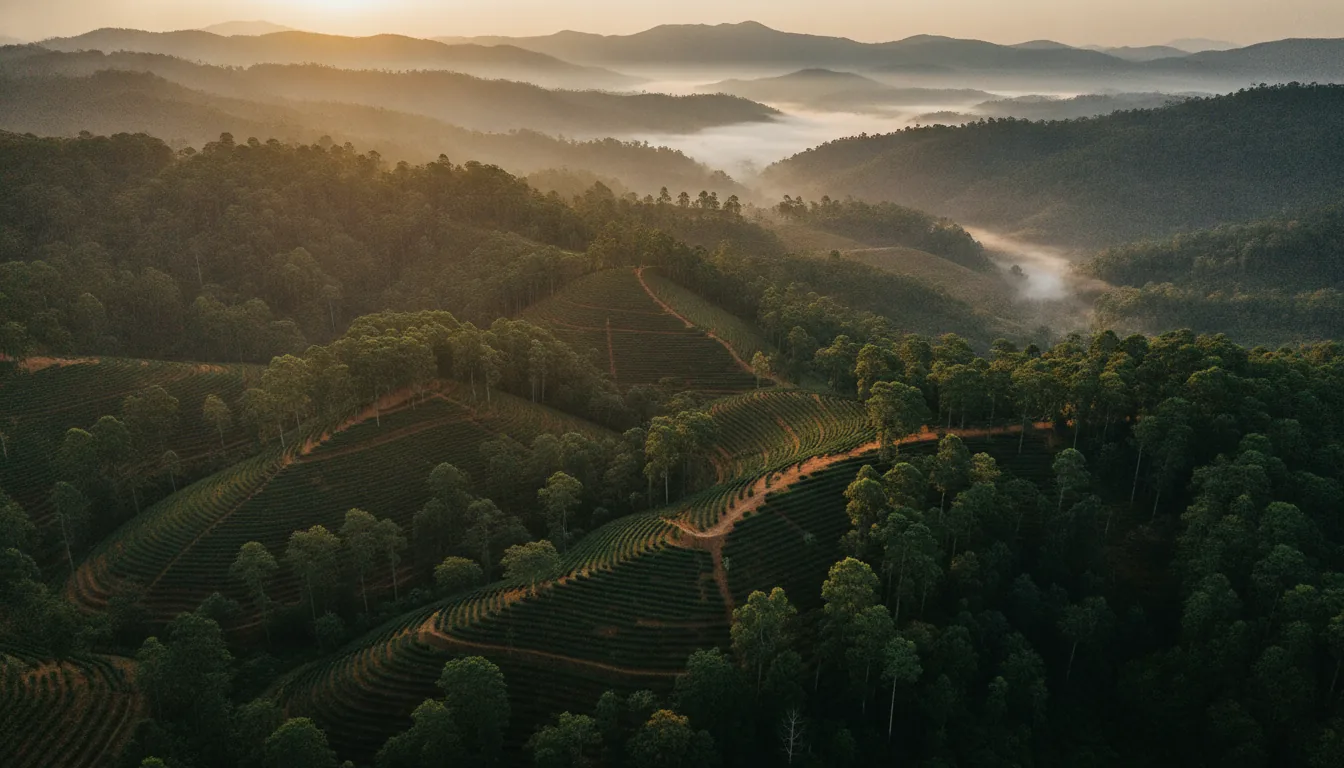
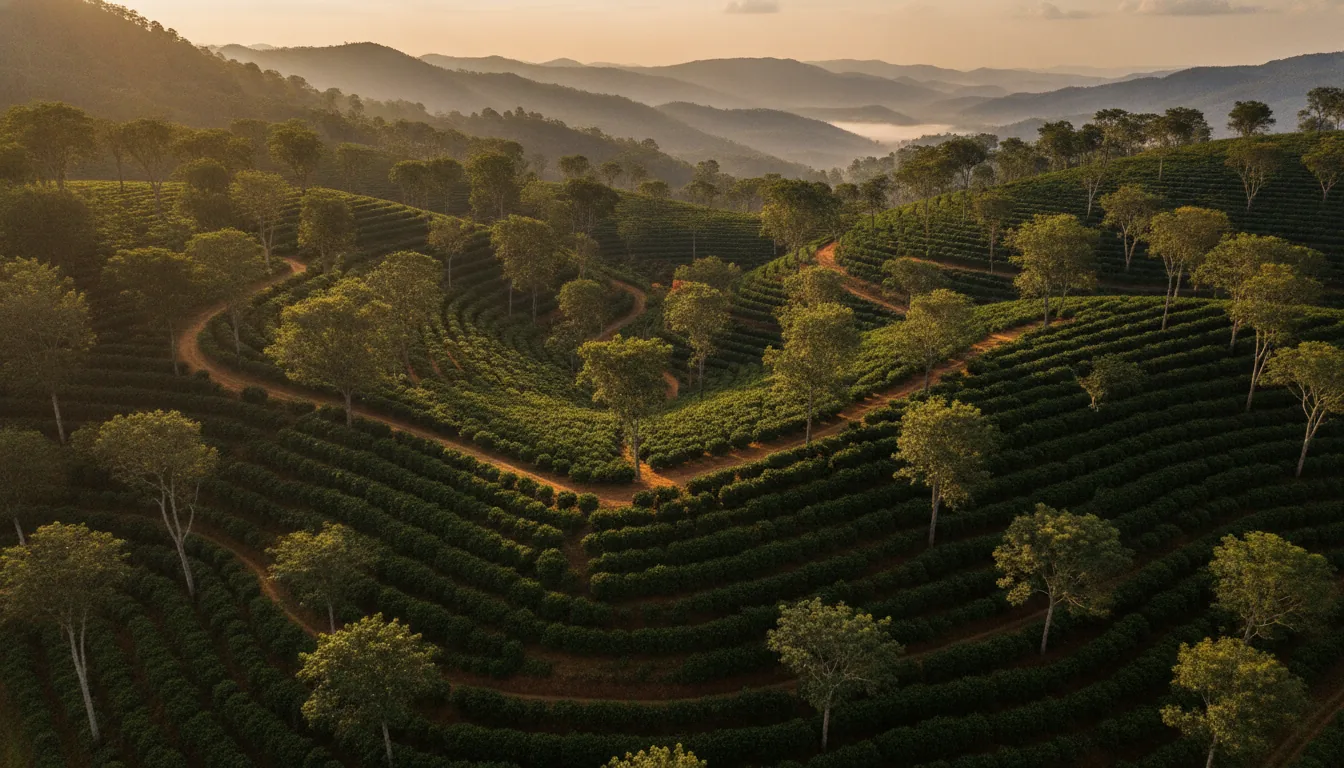
Altitude, rainfall and shade. The Coffee Board places Chikmagalur’s growing zone between 700 and 1,200 metres above mean sea level, with annual rainfall from 1,000 to 4,500 millimetres. Coffee here grows under a two tier shade canopy on acidic Malnad soils.
The district sits inside the Western Ghats, in the belt Karnataka calls malnad: forested, hilly, heavy with rain. Chikmagalur town stands at 1,090 metres above mean sea level, around 240 km from Bengaluru. The Yagachi river rises near the town and Bhadra Wildlife Sanctuary lies in the same region, which tells you what kind of country these estates are cut into.
The soils are acidic, with good organic matter but generally poor phosphorus and potash. In Koppa, Mudigere and Sringeri the lateritic soils are acidic and deficient in nitrogen, potash, phosphorus and lime, over an underlying geology of Archaean gneiss and schist. None of that makes the land difficult. It makes it land that has to be farmed knowingly rather than left alone.
Shade is the other half of the answer. All Indian coffee grows under two tiers of shade and is commonly intercropped with spices. The Coffee Board lists pepper, cardamom, arecanut, orange and vanilla as Chikmagalur’s intercrops. That is why a coffee estate in this belt is rarely only coffee: pepper vines climb the shade trees, timber forms the upper tier, and the three work as one system rather than three separate crops.
Chikmagalur Arabica and why it carries a GI tag
Chikmagalur Arabica is a Geographical Indication, certified by the Department for Promotion of Industry and Internal Trade as one of five Indian coffee GIs. It covers coffee grown in Chikmagalur district, situated on the Deccan plateau and belonging to the Malnad region of Karnataka.
A Geographical Indication is a legal statement that a product’s character comes from where it is grown. Chikmagalur Arabica holds that status alongside Coorg Arabica, Wayanaad Robusta, Araku Valley Arabica and Bababudangiris Arabica. Two of those five names are hills inside this one district, which is unusual for any growing region in India.
The certification’s own description of the coffee is worth reading closely: processed by natural fermentation, with full body, acidity, mild flavour and a striking aroma carrying a note of chocolate. Indian coffee more broadly is grown under shade, hand picked and sun dried.
For a buyer, a GI is the strongest third party proof on offer. It is not an estate’s marketing claim or a resort’s copywriting. It is a national certification that coffee from this district is distinct because of this district. What it does not say is that the district is uniform, because it is not.
Where in Chikmagalur the coffee actually grows
Across the district, but unevenly. The higher Arabica band sits in Baba Budangiri and the Malnad areas. Koppa, Mudigere and Sringeri carry lateritic soils, and a wide rainfall range separates the wet Malnad west from the drier eastern belts.
Rainfall between 1,000 and 4,500 millimetres is not a description of one place. It is a description of several. Mudigere reports mean annual rainfall of around 2,173 millimetres in the 1996 to 2005 record and produces softer, sweet Arabicas with good body. Move east across the same district and it gets drier, and the coffee changes with it.
Balehonnur sits on the western side, close enough to the wet belt that it became the district’s research base. Koppa and Sringeri share the lateritic soil profile. Baba Budangiri holds the high ground where the story began and where the higher Arabica band still sits.
For perspective against the neighbouring belts, the Coffee Board puts Coorg at 750 to 1,100 metres with 1,000 to 2,500 millimetres of rain, and the Manjarabad belt around Sakleshpur and Hassan at 900 to 1,100 metres with a similar rainfall band. Chikmagalur’s range is wider at both ends. Which corner suits which crop is a longer question than one page can settle.
Why there is a coffee research institute at Balehonnur
Because this district’s coffee was worth studying. The Central Coffee Research Institute started in 1925 under the stewardship of Dr. Leslie C. Coleman and now spans 119.86 hectares at Balehonnur. Chikmagalur’s agronomy has been researched on site here for a century.
An institute of that size does not get built for a marginal crop. It was placed here because this is where Indian coffee was, and it has stayed here through every change in the industry since.
Its practical output shows up in the variety names already on this page. Rust tolerant selections such as Cauvery and the Chandragiri line, and the continued dominance of S.795, come from decades of selection work in Indian conditions rather than imported assumptions. When an estate in this belt plants a variety, it is planting something tested a short drive away.
That research, and the estates around it, are held by a very particular kind of owner.
Who owns Chikmagalur’s coffee land today
Mostly small growers. Of roughly 250,000 coffee cultivators in India, 98 percent are small growers, and holdings under 10 hectares account for 71.2 percent of the total area. Karnataka produces 71 percent of India’s coffee.
That structure surprises people who picture coffee country as a handful of colonial estates. It is the opposite. Indian coffee is a smallholder crop, and Karnataka, which grows 71 percent of the national crop with Kodagu district alone contributing 33 percent of it, is farmed largely in holdings of a few hectares each.
It also reframes what owning coffee land here would mean. A person holding a small piece of coffee country is not an outlier in this district. They are typical. The real difference between one small holding and another is not the size of it. It is whether the coffee, the shade trees, the pepper and the boundary are being actively managed, and by whom.
What this heritage means if you are thinking about owning here
It means the land already works. A holding in this belt sits inside a three hundred year old growing system with proven varieties, an established shade structure and a research institute behind it. What differs between one holding and the next is whether that system is being managed.
Heritage is not something that can be added to land later. Either coffee has been grown on it for generations, with the soils, shade trees and tested varieties that come with that, or it has not. In Chikmagalur it has, which is why the district’s name does real work rather than decorative work.
The distinction that matters after that is practical. A registered holding with a full managed service behind it means the coffee and pepper are farmed on a schedule, the boundary is fenced and secured, roads and water are maintained, and the owner has a named relationship manager to call. A bare, unmanaged holding is land and nothing else, and every one of those tasks becomes the owner’s own project. Both are legitimate purchases. They are simply not the same purchase, and the difference shows up in the second year rather than the first.
Acres Community works on the managed side of that line: half-acre units of managed coffee estate, each registered in the buyer’s own name, with coffee, pepper and timber worked as one estate. Chikmagalur is a region we are reading closely rather than selling in today, which is why this is a primer and not a listing. While the world visits, you belong.
If the district holds your interest, the next page to read is the region page: the Chikmagalur estate country Acres Community is building toward.
Frequently asked questions
How did coffee come to Chikmagalur?
By tradition, Baba Budan carried seven coffee beans back from Yemen in the seventeenth century and planted them in the Chandragiri hills, the range now called Baba Budangiri. The Chikkamagaluru district administration dates the first coffee grown in India to 1670 A.D. at that site.
What is the story of Baba Budan coffee?
Baba Budan is remembered as a Sufi ascetic who carried seven coffee beans out of Mokha in Yemen, where exporting fertile beans was forbidden, and planted them on his return. Some retellings name Mecca instead. The hills he planted on carry his name today.
Which coffee is famous in Chikmagalur?
Chikmagalur Arabica, which holds a Geographical Indication certified by the Department for Promotion of Industry and Internal Trade. It is processed by natural fermentation and described as full bodied, with acidity, mild flavour and a striking aroma carrying a note of chocolate.
Is Chikmagalur coffee Arabica or Robusta?
Both. Coffee Board of India figures give the district 37,000 hectares of Arabica producing 29,000 metric tonnes and 23,000 hectares of Robusta producing 30,000 metric tonnes. Arabica varieties include S.795, Sln.5B, Sln.9 and Cauvery. Robusta varieties include Peridenia, S.274 and CxR.
Is Chikmagalur the coffee capital of India?
The phrase is used loosely. Chikmagalur is where Indian coffee began and remains a major producing district, but Kodagu produces more, contributing 33 percent of national output against Karnataka’s 71 percent overall. Chikmagalur’s stronger claim is birthplace rather than volume.
Coffee has been grown in Chikmagalur for three centuries, researched here for a hundred years, and certified as its own thing since the 2019 Geographical Indication. The heritage is real and it is documented. What it does not tell you is what owning a piece of it involves, which is where the region page picks up: Chikmagalur coffee estates and what Acres Community is planning there.