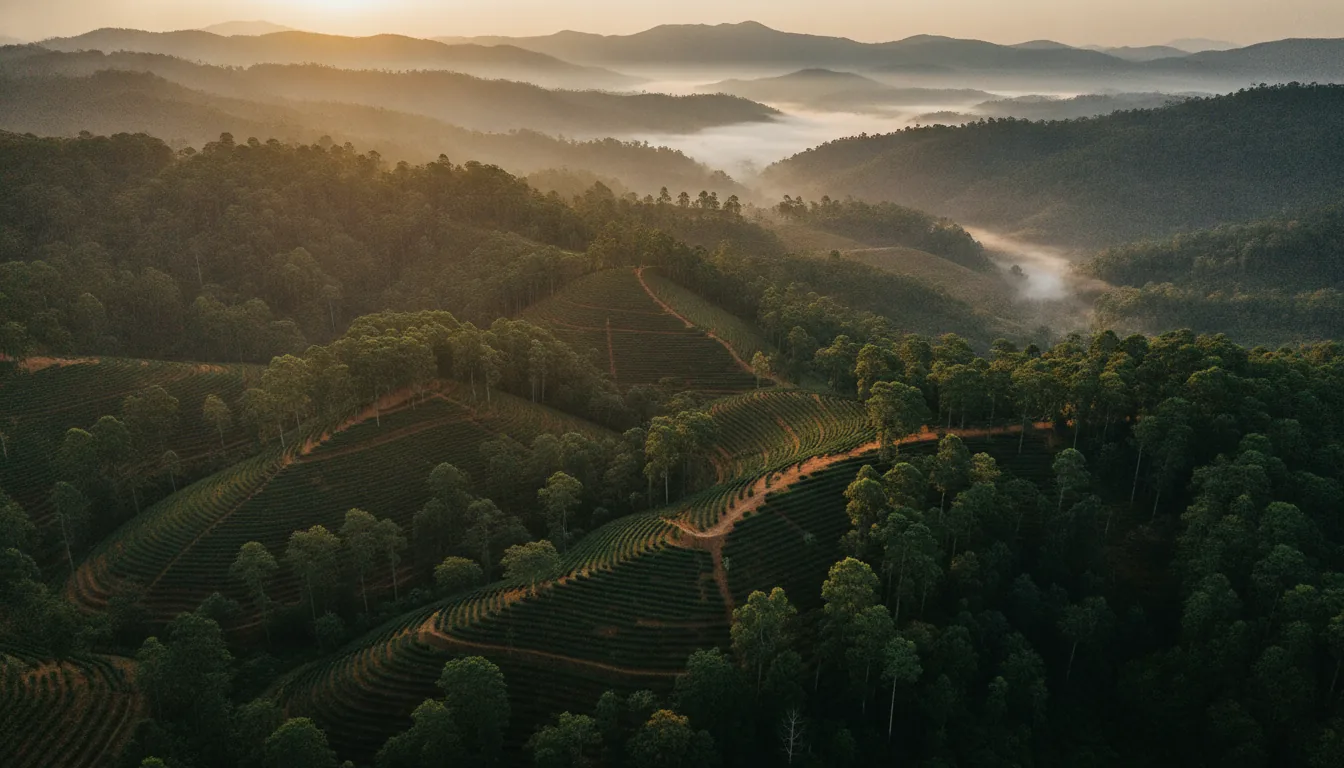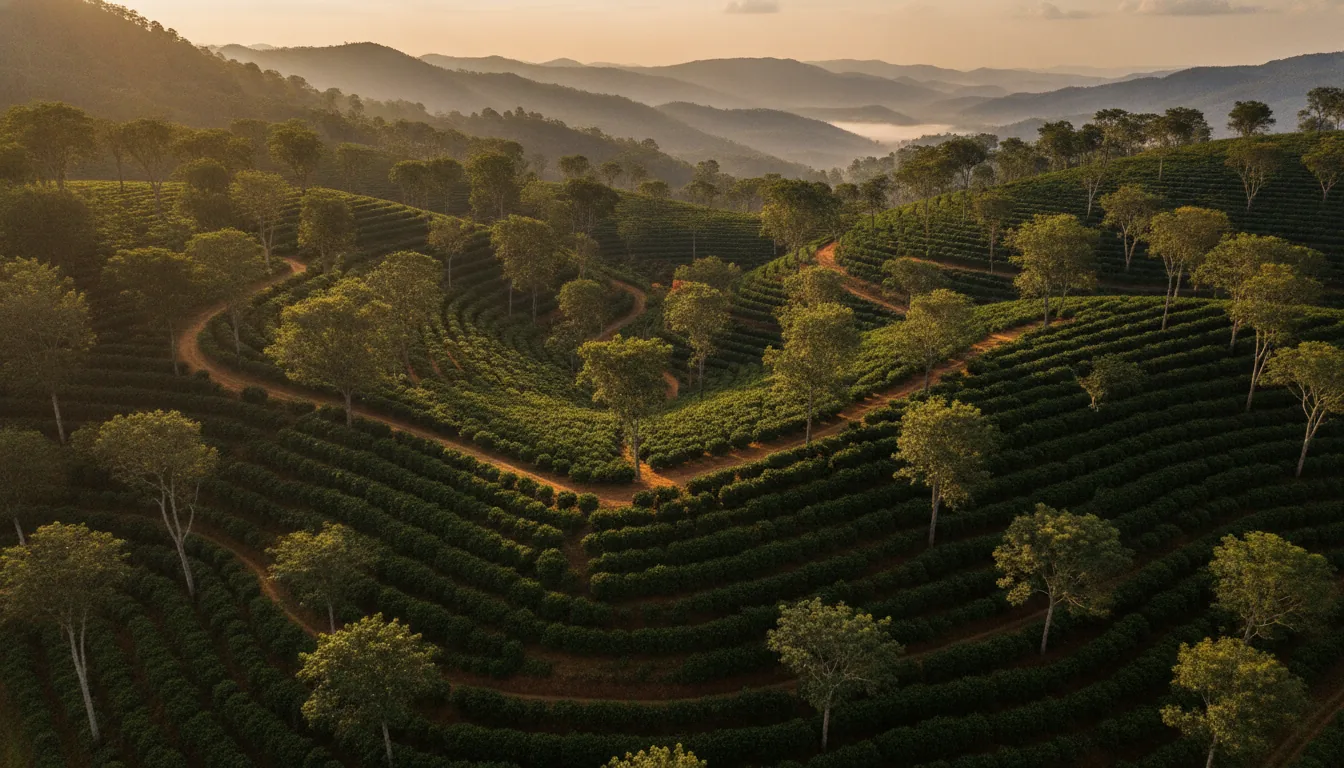

A coffee estate is never only coffee. Look closely and you are standing inside a layered, living system: tall trees overhead, coffee bushes in their shade, pepper vines climbing the trunks, all sharing the same soil and the same seasons. If you are going to own one, it helps to see how that system actually holds together.
DIRECT ANSWER
Coffee grows in the shade of tall trees, black pepper climbs those same trees, and the shade trees, chiefly silver oak, are a long-horizon timber crop in their own right. Three crops share one canopy, cared for on a single seasonal calendar of shade regulation, pruning, weeding, pest control, harvest and processing.
Table of Contents
What does a three-crop coffee, pepper and timber estate actually look like
Picture three layers on one piece of land. Tall shade trees form the top canopy, coffee bushes grow in their filtered light below, and black pepper vines climb the tree trunks between them. Those trees are largely silver oak, which is also the estate’s timber. One landscape, three crops, one calendar.
Indian coffee is grown under a canopy of native and planted shade trees and is intercropped with pepper, with silver oak commonly used as a second tier of shade. So the thing you would own is not a flat field of one crop. It is a working estate with structure to it: an overstorey of trees, an understorey of coffee, and vines threading up between the two.
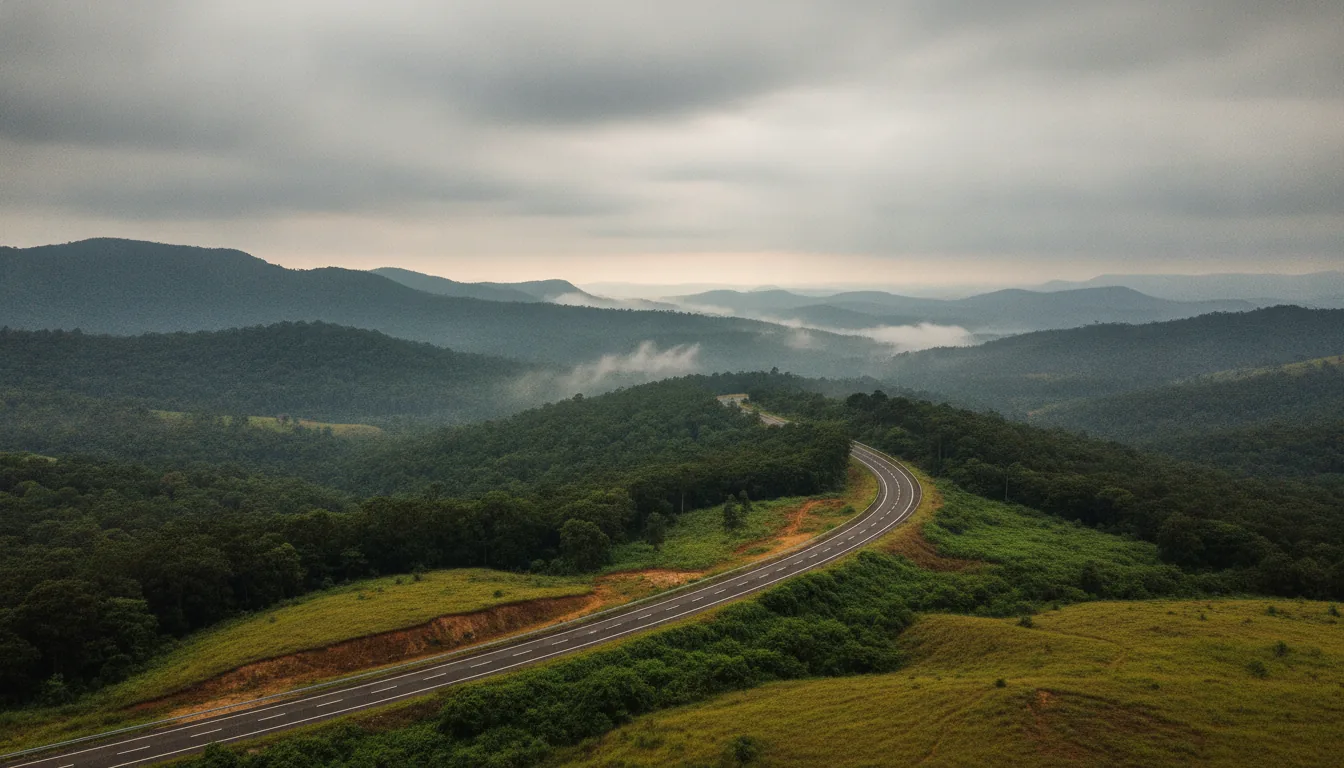
This system belongs to the hill country of the Western Ghats, the Malnad belt of Karnataka where Belur and Sakleshpur sit. The point to hold before going crop by crop is that these are not three separate farms squeezed together. They are one estate whose parts depend on each other, which is exactly why they are planted together.
Why are coffee, pepper and timber grown together
Because each one supports the others. The shade trees shelter coffee from harsh sun and weather, their trunks give pepper a living support to climb, and the same trees mature into timber. Grown together they share soil, shade and a single care routine, making one varied, resilient estate instead of three separate farms.
The shade canopy does real ecological work. A two-tier canopy of shade trees shelters birds and natural pest predators, cuts soil erosion, recycles nutrients back into the ground through leaf litter, and buffers the coffee bushes against heat and heavy weather. Coffee grown this way is steadier and healthier than coffee pushed out into open sun.
Pepper belongs here because it asks for almost nothing new. It is a climbing vine that must have a living support to grow, and the shade trees are already standing there. Silver oak, meanwhile, is deep-rooted and competes little with the crops around it, so it can carry both the shade and the pepper without starving the coffee. Same soil, two crops on it, and a third growing quietly in the trees themselves. That interdependence starts with how the coffee is grown.
How is the coffee itself grown and cared for
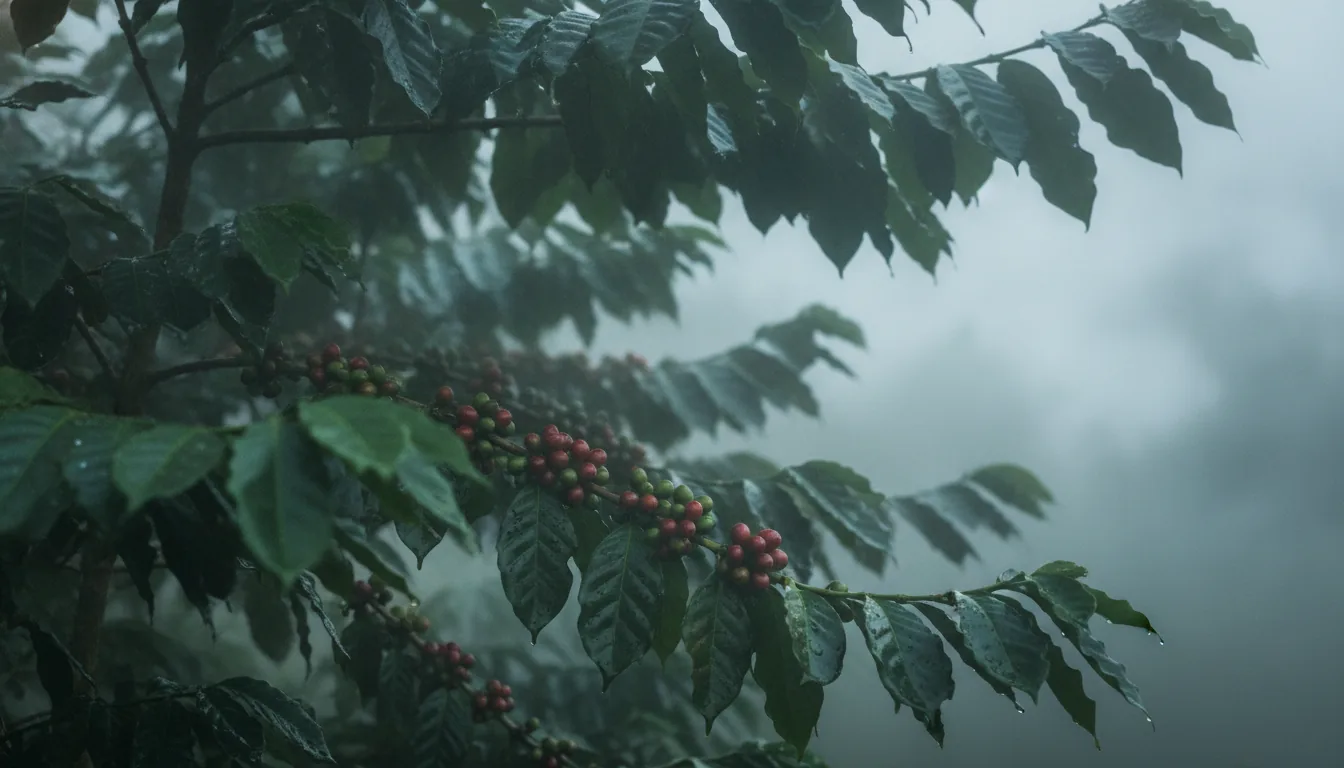
Coffee here is shade-grown, both arabica and robusta, raised under a two-tier canopy rather than open sun. Its care runs year round: shade regulation, pruning, weeding, mulching, manuring, and pest and disease control, building toward the harvest, when only ripe red cherries are hand-picked.
The two-tier canopy pairs temporary trees with permanent ones. Fast-growing dadap is planted to shade young coffee in its early years, while permanent species such as silver oak, Ficus, Albizzia and jackfruit form the lasting overstorey. The shade is regulated every year, not once in three or four, so the bushes are never shocked by a sudden change in light and the canopy never traps too much damp.
The health work is specific. A Bordeaux spray of quicklime and copper is applied to manage leaf rust, in line with Coffee Board of India guidance, and mulch and intercrops help steady the soil and deter pests. None of this is guesswork; it follows a known plant-protection routine that trained estate staff run on schedule.
After picking, the coffee is handled with care that decides its quality. Only fully ripe red cherries are taken, pulped the same day, washed, and dried on mesh trays and then yards, covered at night, until they reach roughly ten to twelve percent moisture, then stored in clean, ventilated godowns. With the coffee understood, the second crop is the one climbing the trees above it.
How does black pepper fit into a coffee estate
Black pepper needs no separate land. It is a climbing vine grown on living supports, and on a coffee estate the vines are trailed up the shade trees already standing over the coffee. The same trees that shelter the coffee become the pepper’s living poles, so a second crop grows on the same ground.
Pepper, Piper nigrum, is grown across India on living standards rather than dead posts, because a living tree lasts, holds the vine well, and gives the partial shade pepper likes. On a coffee estate the choice of standard is easy, because the shade trees are already in place and doing the job.
Silver oak is the most widely used living support for pepper. It is fast-growing, gives the right partial shade, and is easy to manage as the vine climbs. This is why Karnataka’s main pepper districts, including Kodagu, Shivamogga and Chikkamagalur, are the same hills where shade-grown coffee thrives. The two crops keep the same company. And the tree carrying both of them is worth a section of its own.
What is the role of timber, and why silver oak
Silver oak is the linchpin. It shades the coffee, supports the pepper, and grows into the estate’s timber, doing three jobs from one tree. That triple role is what makes the coffee, pepper and timber model work as one connected system rather than three crops competing for the same ground.
Silver oak, Grevillea robusta, has been planted as high shade for coffee for well over a century. It is often pollarded, cut back to spread its crown, so it throws even shade without towering unchecked, and it tolerates heavy pruning, which lets the estate regulate how much it competes with the crops below. Deep roots keep that competition low to begin with.
Across its working life, roughly forty to fifty years before a tree is replaced, silver oak also supplies poles, firewood and leaf mulch that feeds back into the soil. Its wood is light, durable and termite-resistant, the kind used for furniture, plywood, doors and paneling. That is why it counts as a genuine third crop and not just scenery: it is doing useful work overhead the entire time the coffee and pepper grow beneath it. Keeping all three healthy is a matter of timing, which is what the yearly calendar is for.
What does the yearly care calendar look like
The estate is worked all year, not only at harvest. The rhythm moves through pruning and shade regulation, pre-monsoon manuring and disease spraying, monsoon weeding, then the harvest and its processing. Each season carries its own task, and the land is never left to fend for itself between crops.
Early in the cycle come pruning and pre-monsoon work: manuring the coffee and applying the Bordeaux spray before the rains, and lopping the shade so the canopy is opened up for the wet months ahead. Shade management here is active, skilled work. Trees are climbed, thinned and trimmed before and during the monsoon, because too much canopy traps damp and raises disease pressure, and opening it up each year keeps the bushes healthy.
Weed control follows the rains in a clear sequence: a pre-monsoon spray, slash weeding through the middle of the monsoon, and a post-monsoon spray. Then the calendar builds to its busiest point. Harvest is the most labour-intensive stretch of the year, when ripe cherries are hand-picked and moved straight into pulping, drying, sorting and grading. Pepper is gathered on its own timing from the vines, and the timber simply keeps growing. All of this raises a fair question: who actually does it?
Who does all this work, and what does the owner have to do
A resident, skilled team does all of it. Coffee cultivation is a trained discipline, and the shade, pepper and timber work is theirs to plan and carry out. As the owner, you are not required to farm anything. You own the estate, and the managed model runs it on your behalf through the year.
This is where crop care meets the service that surrounds it. The seasonal work described above is only one part of a wider managed operation that also keeps the estate secure and its roads, fencing and water in order. Those parts have their own page; here it is enough to say the crops are in trained hands. For the full picture of the managed model behind the crops, follow the hub.
If you want the plainer breakdown of what the management service covers day to day, the sibling article on [what ‘professionally managed’ actually means -> /blogs/what-does-professionally-managed-mean] walks through it (recommendation). Either way, the owner’s job is to own. You need no farming knowledge to hold a three-crop estate, because the knowledge lives with the team who work it. To see the model on real ground, it helps to look at an actual estate.
Which crops grow on Acres estates like Euphora
All three. Euphora, the estate we manage in the Belur-Sakleshpur belt, grows coffee, pepper and timber together as one working system. It is the three-crop model described on this page, standing on real ground in the Malnad hills, cared for through the same yearly calendar of shade, pruning, weeding, harvest and processing.
Everything on this page stops being theory when you put it on a specific piece of land. The coffee under its two-tier shade, the pepper climbing the silver oak, the timber growing overhead, and the year-round care that holds it together are all present on the estates Acres Community manages. You can see the estate itself to picture how the layers sit together in one place.
This is the heart of what owning here means. You are not buying a coffee field. You are taking on a living three-crop estate, run for you, in the hills where this system belongs. While the world visits, you belong.
Frequently Asked Questions
Why is coffee grown under shade instead of open sun?
Shade protects coffee from harsh sun, wind and sudden temperature swings, and the canopy shelters natural pest predators, recycles nutrients through leaf litter, and reduces soil erosion. Shade-grown coffee is the traditional method across the Western Ghats, and the shade itself is regulated every year to keep the bushes healthy.
Does black pepper need separate land on a coffee estate?
No. Black pepper is a climbing vine grown on living supports, so on a coffee estate it trails up the shade trees already standing over the coffee. The same silver oaks that shade the bushes become the pepper’s poles, adding a second crop without adding land.
Is silver oak grown for shade or for timber?
Both. Silver oak is planted first as high shade for the coffee and as a living support for pepper, and over its working life it also grows into the estate’s timber. One tree fills three roles across the years, which is why it anchors the three-crop model.
Do coffee, pepper and timber all get harvested at the same time?
No. The coffee harvest is the busy season, when ripe red cherries are hand-picked and processed. Pepper is gathered on its own cycle from the vines. Timber is a long-horizon crop, cut only when a silver oak reaches the end of its working life, not on a yearly schedule.
One estate, three crops, cared for all year
A coffee estate holds together because its crops are planned as one system and worked through every season. If you want the wider view of how such an estate is run, see how a managed coffee estate is run, and to see the three-crop model on real ground, visit the coffee, pepper and timber estate we manage in Belur-Sakleshpur.
When you are ready to talk about a three-crop estate of your own, enquire for current pricing and availability.