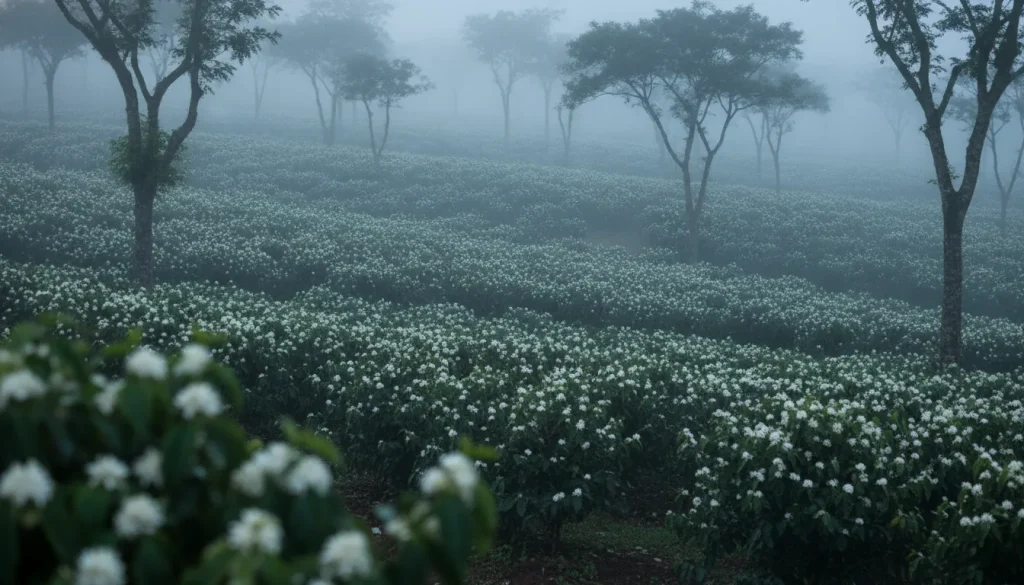
For a few days each year, the coffee on Karnataka’s estates turns white and the air between the rows smells faintly of jasmine. That is coffee flowering, and here it runs on rain, not on the calendar. This guide covers when the bloom comes, what sets it off, and why the second rain matters as much as the first.
The short answer
In Karnataka, coffee flowers once the pre-monsoon blossom showers break the dry season, typically February to March for robusta and March to April for arabica. The small white flowers open within days of a good shower, and each one lasts only a day or two. A second round of rain, the backing showers, then helps the young fruit set.
In this guide
What does a coffee flower look like and smell like
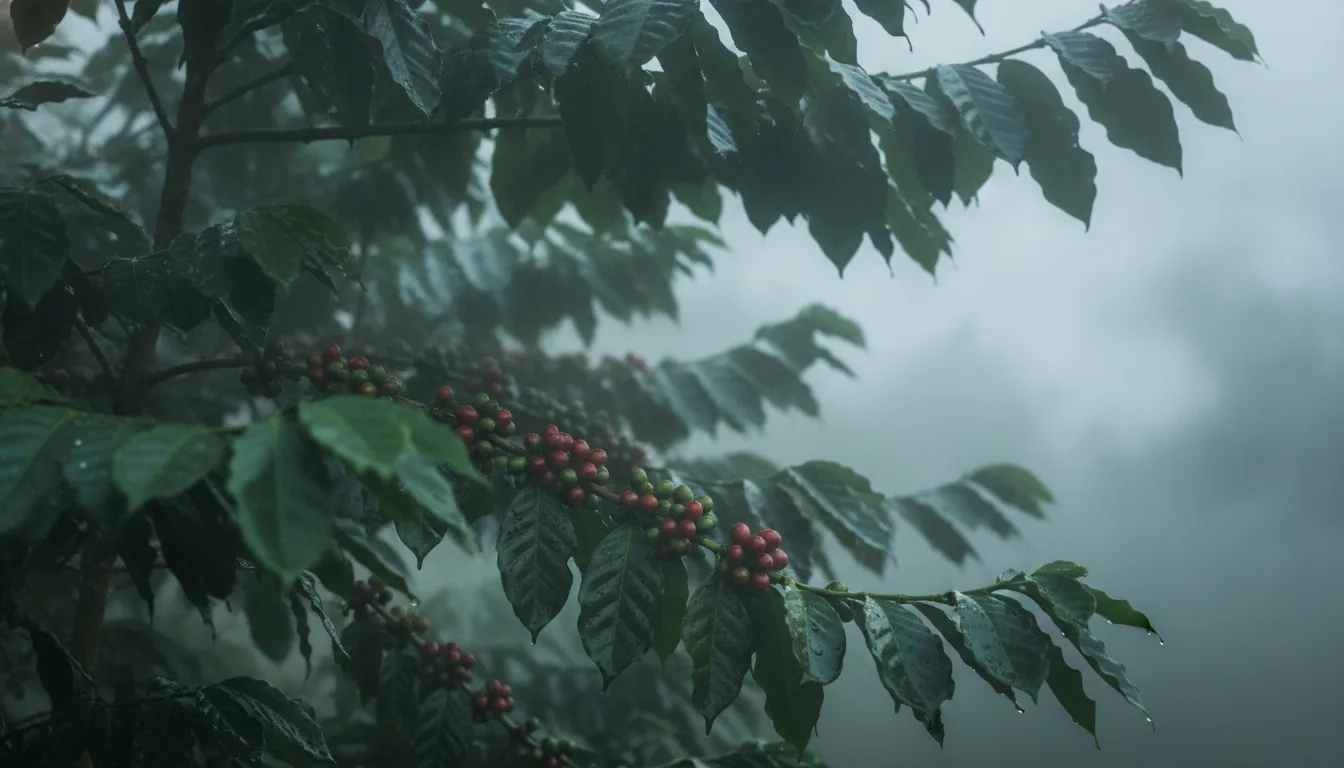
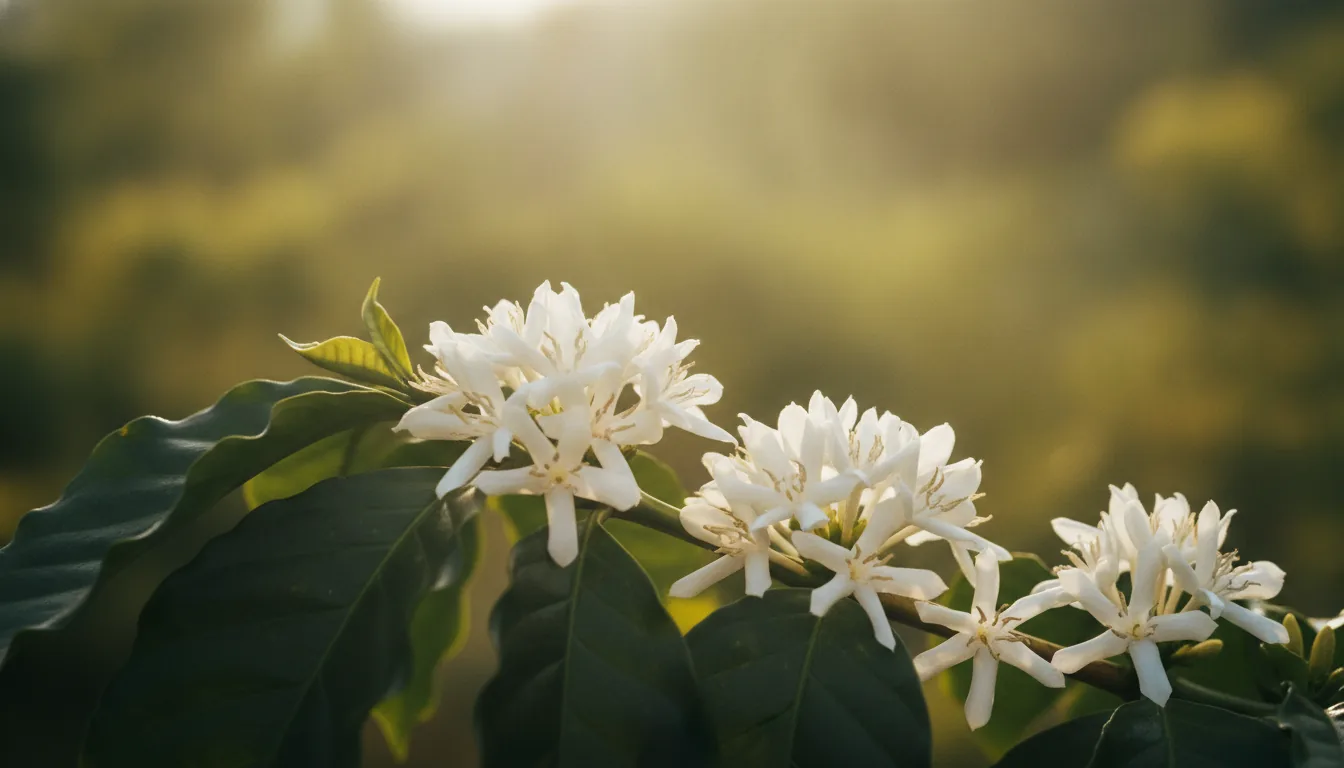
A coffee flower looks like a small white star, roughly a centimetre across, and grows in tight clusters where the leaf meets the branch. It smells like jasmine with a hint of citrus blossom, not like coffee.
The coffee genus, Coffea, belongs to Rubiaceae, a family of flowering plants. A branch in full bloom carries white clusters from one end to the other.
Kauai Coffee, a grower in Hawaii, compares the scent to jasmine with a little citrus blossom in it, and Coffee Review notes a slightly pungent edge. Nothing about it smells of coffee.
A young coffee plant takes its time. It usually starts flowering only after about three to five years of growth.
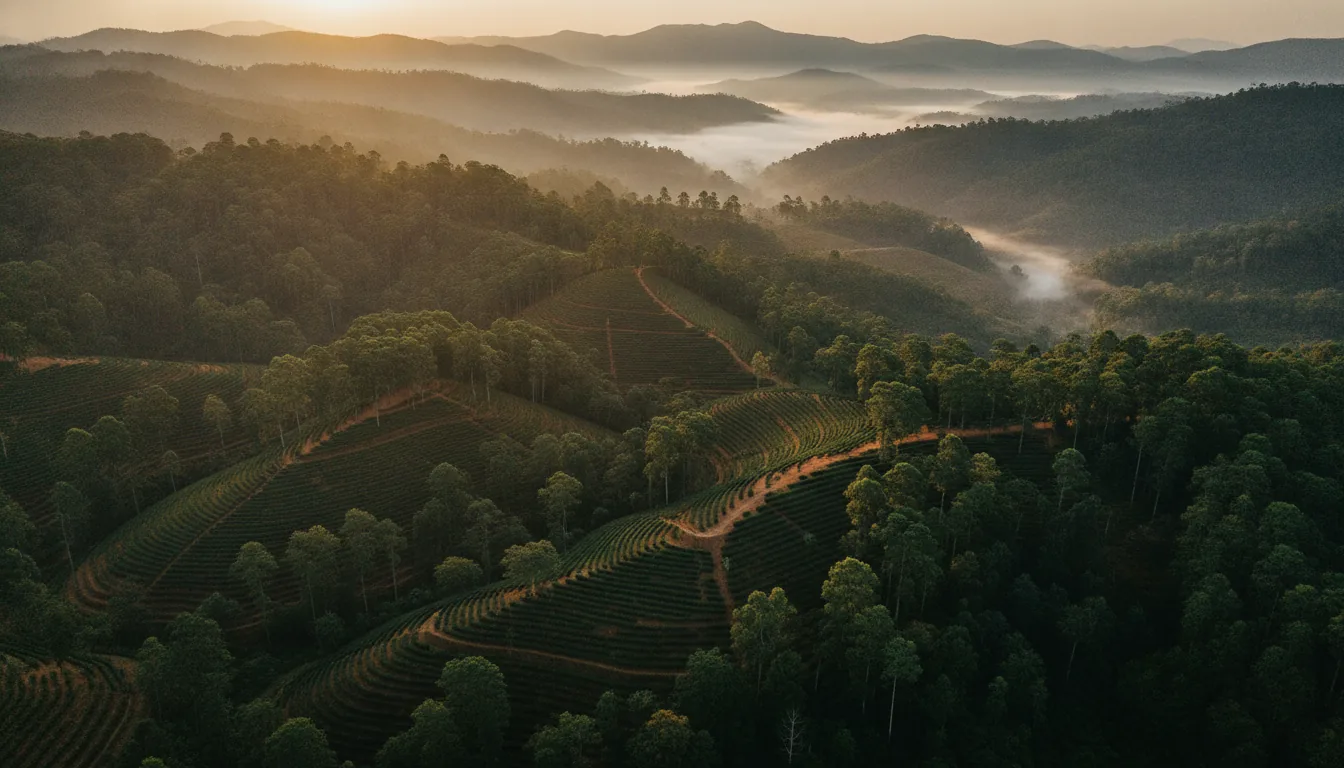
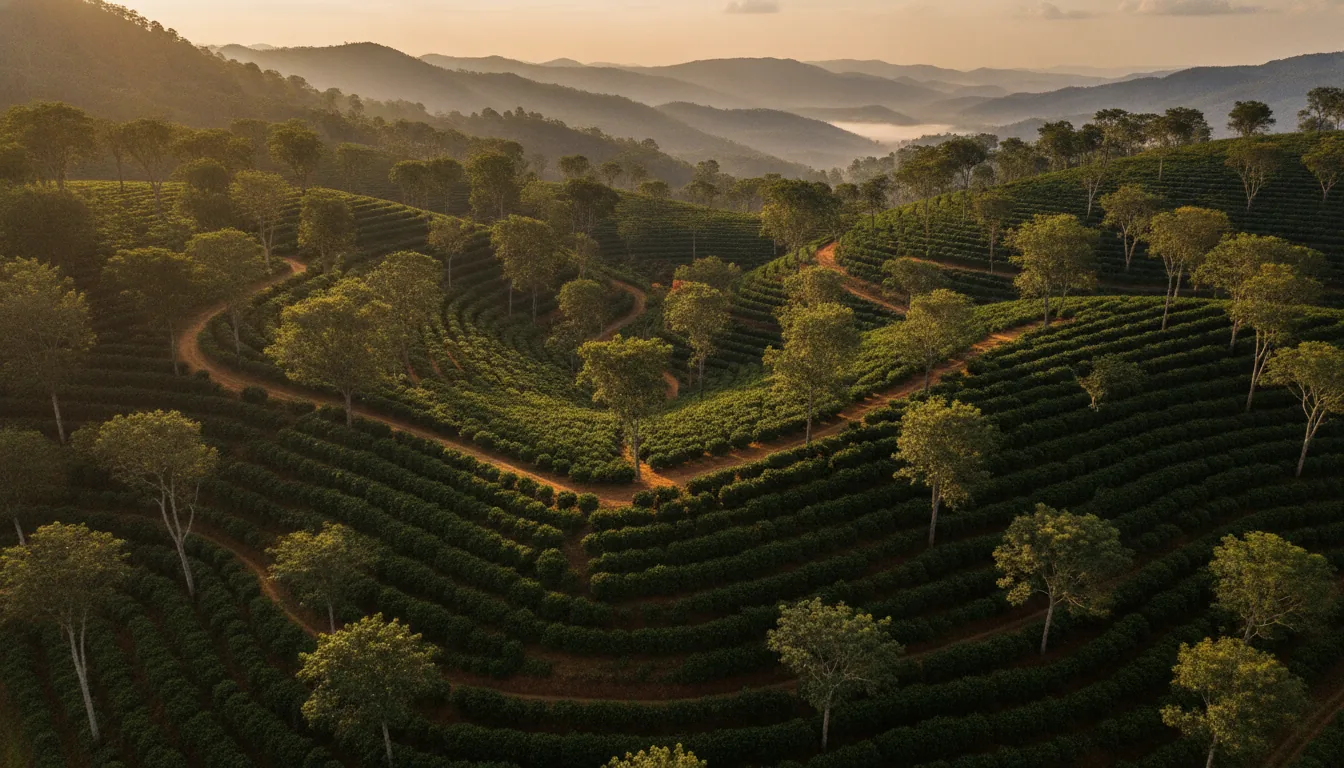
In Karnataka, the bloom opens under shade. The Coffee Board notes that India is the only country that grows all of its coffee under shade, beneath a two-tier mixed canopy, so the flowers open in filtered light below the shade trees, silver oak shade among them. Under that canopy, what decides when the flowers open is the rain.
When does coffee blossom in Karnataka
Coffee usually blossoms in Karnataka between February and April, but the trigger is rain, not a date. Robusta typically blossoms in February to March and arabica in March to April, once the first good pre-monsoon showers end the dry months.
The months only tell you where to look. Through the dry season the flower buds form and then wait, held back by the lack of water. The first significant rain after that dry spell releases them, and most buds on a plant open together.
Because the shower is the switch, the bloom moves with the weather. An early shower brings the bloom forward, a late one pushes it back, and a patchy one can break it into several smaller flowerings. That is why the bloom can fall in different weeks from one year to the next on the same estate, and why no one can promise a fixed date.
Where the bloom sits among the rest of the estate year is set out in the yearly care calendar on a three-crop estate.
For the rain and temperature through the rest of the year, see Sakleshpur weather month by month.
The rain that does the work has a name of its own.
What are blossom showers
Blossom showers are the pre-monsoon rains that make coffee flower in Karnataka, usually between February and April. They are part of the same seasonal rain known elsewhere as mango showers, which Karnataka calls cherry blossom showers or coffee showers.
Blossom showers are the first pre-monsoon rains that make coffee plants flower in Karnataka. Mango showers is the wider colloquial name for the same season of rain.
The Coffee Board puts the rain a blossom shower needs at about 25 to 40 mm. A rainfall insurance scheme for coffee growers in Chikkamagaluru, Kodagu and Hassan, designed with the Coffee Board and the Central Coffee Research Institute, treated about 25 mm over five consecutive days as a normal blossom shower for arabica, and 20 mm for robusta.
The season itself is the pre-monsoon, which the India Meteorological Department counts as March to May. For coffee, the showers that matter fall at the early end of it, and for robusta the Coffee Board’s window opens as early as February. Across the Western Ghats coffee districts of Karnataka, this is the rain growers wait for.
The names are where students get tripped up. Mango showers is a colloquial term for pre-monsoon rain in Karnataka, Kerala and parts of Tamil Nadu, and the rain matters to crops like mangoes and coffee. In Karnataka the same rain is called cherry blossom showers or coffee showers, because this is when the coffee flowers. Some study sites swap the names between states.
A blossom shower opens the flowers. Keeping what those flowers become takes a second rain.
What do backing showers do
Backing showers are the follow-up rains, a few weeks after the blossom shower, that help coffee plants keep the young fruit their flowers have set. The Coffee Board puts the need at about 50 to 75 mm, well spread out.
The timing follows the species. The Coffee Board places backing showers in April to May for arabica and in March to April for robusta. The insurance scheme above counted backing rain from roughly the third to the sixth week after the blossom shower began, for what it called fruit development and retention.
Retention is the point. A pollinated flower leaves behind a tiny fruit that the plant still has to carry, and moisture in the weeks after the bloom helps it stay on the branch. The US Department of Agriculture’s coffee report on India credited good backing showers in one season with having aided fruit setting and development.
Both rains matter, and neither is guaranteed.
What happens when the blossom rains fail or come early
When blossom rains fail or come early, coffee flowering can be delayed, uneven, split into smaller blooms or set off out of season. Growers with water often run sprinklers to create an artificial blossom shower, known as blossom irrigation.
When rain falls in patches, so does the bloom. Trade reporting on India’s coffee season has described scattered showers setting off several separate blossoms instead of one even flowering. A delay hurts too. The USDA’s report on Indian coffee linked one weaker season to blossom and backing showers that arrived late, combined with high temperatures.
Growers who have water do not always wait for the sky. Kerala Agricultural University’s coffee notes describe overhead sprinklers used in February to April to ensure blossom, and backing as well if needed. Where growers can irrigate, they often water robusta first, and trade reporting mentions this in Hassan and in the drier pockets of Kodagu and Chikkamagaluru.
Arabica, grown higher up, is typically rain-fed, and rain-fed growers are more exposed when the shower fails. The Coffee Board’s research arm, the Central Coffee Research Institute at Balehonnur, counts sprinkler and drip irrigation among its agronomy work.
Rain can also come too early or at the wrong moment. Deccan Herald has reported coffee in parts of the Malnad area flowering after untimely rain while the current crop was still waiting to ripen. And rain at peak bloom can wash pollen off the open flowers.
On a managed estate, farming, crop care and water are the estate team’s job, so calls like whether and when to irrigate for the bloom are made on the ground, not left to an owner who lives away. That is part of what professional estate management covers, and if the model is new to you, start with what a managed estate is.
Which species is on the land changes all of this, because arabica and robusta do not flower on the same schedule.
Do arabica and robusta flower at the same time
Arabica and robusta usually do not flower at the same time. Robusta, grown lower and warmer, typically flowers first, in February to March. Arabica, grown higher and cooler, follows in March to April and needs more rain to bloom evenly.
Arabica and robusta bloom at a glance
| Arabica (Coffea arabica) | Robusta (Coffea canephora) | |
|---|---|---|
| Typical elevation | 1,000 to 1,500 m | 500 to 1,000 m |
| Climate | 15 to 25°C, cool and even | 20 to 30°C, hot and humid |
| Blossom showers | March to April, 25 to 40 mm | February to March, 25 to 40 mm |
| Backing showers | April to May, 50 to 75 mm, well distributed | March to April, 50 to 75 mm, well distributed |
| Pollination | Self-pollinating | Needs pollen from a genetically different plant |
The bigger difference for the bloom is pollination. Arabica is self-pollinating, so a plant can set fruit from its own flowers. Robusta cannot. Coffea canephora is self-incompatible, which means its flowers need pollen from a genetically different plant, and research on the species notes that a block of a single clone produces no fruit at all.
That makes insects such as bees matter far more in a robusta bloom. Even in arabica, insect visits can raise fruit set. On land that grows both species, the two windows can mean two waves of white in one season rather than one.
Everything else that separates the two species, from the cup to the bean, is covered in arabica vs robusta.
Whichever species is flowering, the white does not last long.
How long does the coffee bloom last
The coffee bloom lasts only a few days. Each flower stays open for a day or two, and a good shower opens most buds at once, so the white fades quickly. Patchy rain can stretch this into several smaller blooms.
Coffee flowers open early in the morning and are most receptive to pollen in their first 24 hours. By the second day they begin to fade, and the petals soon wither and fall.
The wait after rain is short too. After a good shower or a round of sprinkling, the flowers usually open within about a week.
One bloom is not always the whole story. A coffee tree can carry one or two big blooms in a season with smaller ones in between, more so when the rain arrives unevenly.
For an owner who wants to be there for it, the lesson is simple. Watch the rain, not the calendar. The week only becomes clear once the shower has fallen.
Where the coffee grows shapes the bloom as well.
How does the bloom differ across Belur-Sakleshpur, Chikkamagaluru and Kodagu
The bloom differs across Belur-Sakleshpur, Chikkamagaluru and Kodagu because the belts plant different coffee. Kodagu grows mostly robusta, which tends to flower earlier. Chikkamagaluru and the Coffee Board’s Manjarabad region around Sakleshpur grow more arabica, which tends to flower later.
Coffee Board regions in the three belts
| Coffee Board region | Elevation | Coffee mix |
|---|---|---|
| Bababudangiris (Chikkamagaluru district) | 1,000 to 1,500 m | Arabica only |
| Chikmagalur | 700 to 1,200 m | More arabica than robusta |
| Coorg (Kodagu) | 750 to 1,100 m | Mostly robusta, roughly two to one |
| Manjarabad | 900 to 1,100 m | Mostly arabica, roughly three to one |
In Kodagu, or Coorg, robusta outnumbers arabica roughly two to one, so more of the district’s coffee tends to flower in the earlier window, from February.
Chikkamagaluru leans the other way. It grows more arabica than robusta, and the Bababudangiris, within the district, grow arabica only. More of its bloom tends to come in the later arabica window. The Central Coffee Research Institute works from Balehonnur in this district, with a regional station at Chettalli in Kodagu.
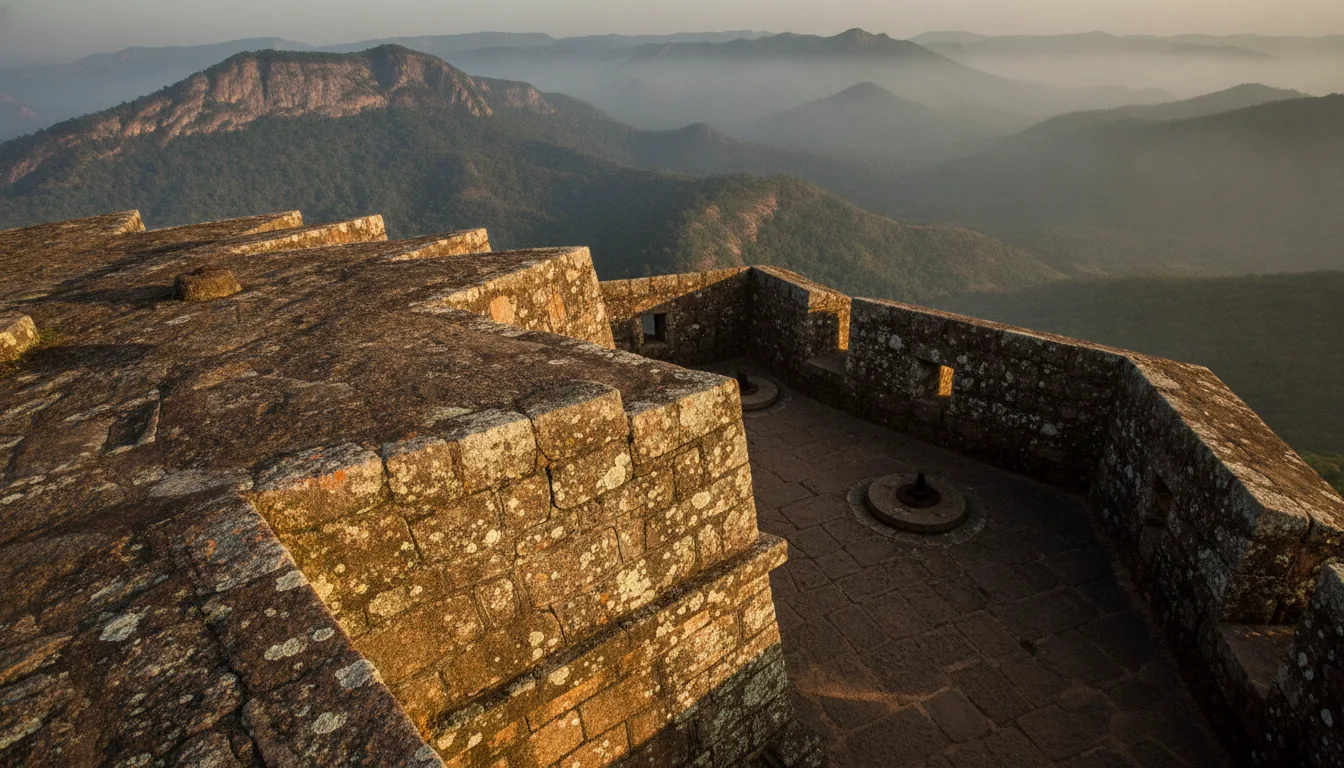
Sakleshpur is a town and taluk in Hassan district, at about 932 m, in the Malenadu, Karnataka’s Malnad hill country. The Coffee Board’s Manjarabad region shares its name with Manjarabad Fort on the outskirts of Sakleshpur and is mostly arabica, so its bloom tends to lean later too. For why the belt suits coffee, read why Belur-Sakleshpur grows coffee so well.
These are tendencies, not rules. Each of the three belts grows both species, the rain falls differently every year, and an estate’s own planting decides its own bloom. None of this makes one belt better than another. All three turn white each year, just not always in the same weeks.
For a wider comparison, see how the three coffee belts differ. For each belt on its own terms, read Chikmagalur’s coffee heritage and Coorg’s coffee, pepper and cardamom belt.
For the weather through the rest of the year in Chikkamagaluru, see Chikmagalur’s seasons.
For Kodagu, see Coorg weather month by month.
Wherever it happens, the bloom is only the first step toward a crop.
What comes after the coffee flower
After the coffee flower is pollinated, its petals fall and leave a tiny green pinhead. Over the following months that pinhead swells into a coffee cherry, and good backing showers help the young fruit stay on the branch.
That pinhead is fruit set, the point where a flower becomes the start of a crop. The cherry then grows and ripens over the months that follow, and picking and processing begin once it turns ripe.
Frequently asked questions
Are blossom showers and mango showers the same?
Yes, they are the same pre-monsoon rain under different local names. Mango showers is the wider colloquial term, used across Karnataka, Kerala and parts of Tamil Nadu. In Karnataka’s coffee districts the rain is called blossom showers, cherry blossom showers or coffee showers, because it is what makes coffee flower.
In which Indian state are blossom showers observed?
Blossom showers are observed in Karnataka, where the name comes from the coffee bloom they trigger. They fall across the state’s coffee districts in the Western Ghats, including Chikkamagaluru, Kodagu and Hassan, usually between February and April by the Coffee Board’s windows.
Do coffee flowers smell like coffee?
No. Coffee flowers smell nothing like a cup of coffee. Growers compare the scent to jasmine with a hint of citrus blossom, and because each flower lasts only a day or two, the fragrance fades almost as quickly as the bloom.
How many times does coffee flower in a year?
Coffee in Karnataka usually has one main bloom a year, set off by the blossom showers. When the rain arrives in patches, the plant can flower in several smaller flushes, and a tree can carry one or two big blooms with smaller ones in between.
How long does a coffee plant take to flower for the first time?
A coffee plant usually flowers for the first time after about three to five years of growth. Until then it grows without blossoming, so a young planting stays green while the mature coffee around it turns white.
Coffee country you can own
Blossom week reads differently when the land is yours. It is the few days your own rows turn white and the scent settles over your half-acre of managed coffee estate, the first sign of next season’s crop on land registered in your name. You are there because it is yours, not because it is a trip.
While the world visits, you belong.
Acres Community’s live project is Euphora, a managed coffee estate in the Belur-Sakleshpur belt. Each half-acre is registered in its owner’s own name with its own land record. Half an acre is the minimum, larger parcels are available, and the estate team handles farming and crop care, security, roads, fencing and water, with a dedicated relationship manager for every owner.
Read more about coffee estates in Sakleshpur, or picture a weekend at your own estate. To learn about Euphora or enquire for current pricing, talk to Acres Community.