What does ‘professionally managed’ actually mean for a coffee estate?
Professionally managed means a skilled, full-time team runs your coffee estate on your behalf across four areas: agronomy, security, infrastructure upkeep, and a relationship manager as your single point of contact. You own the estate. They do the daily work of keeping it healthy and secure.
The phrase gets used loosely, so it helps to break it into its parts. Agronomy is the crop work that keeps the coffee, pepper and timber alive and productive through the year. Security is the on-ground presence that protects your boundaries. Infrastructure upkeep is the maintenance of estate roads, fencing and water so the place stays accessible and irrigated. The relationship manager is the person you actually speak to about all of it.
The word professional is not decoration here. Coffee cultivation is a trained discipline: the Coffee Board of India runs a two-year diploma to train plantation supervisors and managers, and promotes mechanisation for pruning, weeding and harvesting. A managed estate puts that kind of trained hand on your land. If you want the wider definition of the model itself, see [how the managed model works -> /managed-coffee-estate].
One more thing this page assumes, because it shapes everything below: this is a whole estate with a single owner, not a shared block split among many buyers. That distinction changes what management even means, and it is worth holding as you read the four pillars. The first and largest of them is the crop work.
Who looks after the coffee, pepper and timber when I am not there?
A resident agronomy team looks after the coffee, pepper and timber year round. The work never really stops: shade regulation, pruning, weeding, mulching, manuring, and pest and disease control, then the harvest and processing. The busiest stretch is picking season, when the ripe cherries come off the bushes.
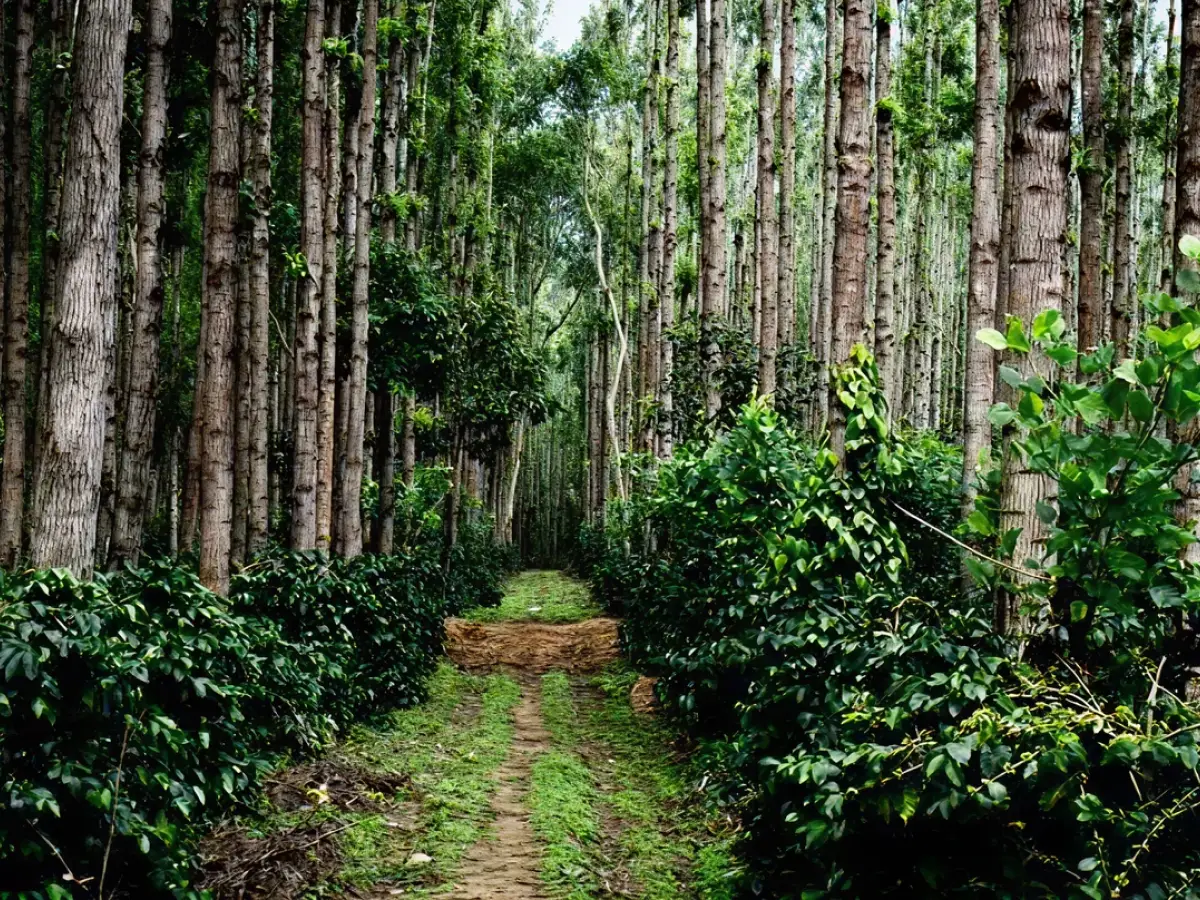
Coffee here grows under a two-tier mixed shade canopy of evergreen trees, which shelters birds and natural pest predators, reduces soil erosion, recycles nutrients through leaf litter, and shields the bushes from harsh weather. That canopy has to be regulated every year, not once in three or four, so the bushes are never shocked by a sudden change in light. The two tiers pair temporary trees like dadap with permanent ones such as Ficus, Albizzia, jackfruit and silver oak.
Managing that shade is skilled, height-risky work. Trees are climbed, thinned and trimmed before and during the monsoon, and where tall areca palms of fifty to eighty feet are intercropped they need their own maintenance cycle. It is one of the most underestimated jobs on an estate, and one of the clearest reasons the service is worth paying trained people to do.
Weed and disease control runs on a calendar, not a whim. Integrated weed control means a pre-monsoon spray, mid-monsoon slash weeding, and a post-monsoon spray. A Bordeaux spray of quicklime and copper is applied to manage leaf rust, in line with Coffee Board guidance, while intercrops such as pepper help deter pests and mulch controls weeds and steadies soil temperature.
At harvest, only fully ripe red cherries are hand-picked. They are pulped the same day, washed, dried on mesh trays and then yards, covered at night, brought down to roughly ten to twelve percent moisture, and stored in clean, ventilated godowns. That is the breadth of it. For the deeper, crop-by-crop picture of how the three crops are cared for together, see [how a three-crop estate is cared for -> /blogs/coffee-pepper-timber-three-crop-estate] (recommendation).
Crops are the reason to own coffee country. Keeping that land intact and yours is the next pillar.
How is my estate kept secure while I am away?
Security means constant on-ground presence and boundary integrity. A managed estate keeps its perimeter fenced and watched, its boundaries clear, and its land protected against encroachment, so the absentee owner’s biggest fear, someone quietly using or claiming the land, does not take hold.
For an owner who lives in the city, this is often the real anxiety behind the whole purchase. An empty estate is a vulnerable one. The management service answers that with people who are physically present on the land, boundaries that are marked and maintained, and fencing that is repaired rather than left to fail.
Encroachment protection matters most on estates that border forest, other holdings or open country. Because the land is a single owned unit rather than a patchwork of small shares, the whole perimeter can be watched as one line, which makes it far easier to notice and stop anything that should not be happening. Security and the physical condition of that perimeter run together, which is where infrastructure comes in.
What about the roads, fencing and water on the estate?
Infrastructure upkeep keeps the estate accessible and watered. It covers estate roads kept passable through the monsoon, fencing maintained along the boundary, and irrigation and water structures such as catch-pits, tanks and channels renovated and cleared so the crops get water and the land drains as it should.
The monsoon is hard on estate roads. Left alone, a season of rain can cut off whole sections of the land, so roads are graded and repaired to stay usable when you or the team need to reach any part of the estate. Fencing along the boundary ties directly into the security pillar and is kept sound rather than patched only when it breaks.
Water is its own discipline. The seasonal work includes renovating catch-pits and water structures so rain is held and directed instead of running off, which keeps the crops supplied and steadies the soil. This is unglamorous, continuous work, and it is exactly the sort of thing an absentee owner cannot do from a desk in the city. Knowing it is handled leads to a fair question: who tells you it is being done?
Who do I actually talk to, is there one point of contact?
Yes. A relationship manager is your single point of contact for the estate. Rather than coordinating field workers yourself, you speak to one person who knows your land, answers your questions, arranges your visits, and handles requests on the ground on your behalf.
Most listings talk endlessly about the farming and go quiet on this part, yet for a remote owner it is the pillar that makes the rest usable. You are not meant to manage a dozen workers or chase updates across a plantation. You have one named person who understands your specific estate and speaks for it to you.
The concierge layer sits inside this relationship. When you want to come to the estate, your relationship manager arranges the visit and takes care of on-ground requests while you are there. This is not a holiday let or a hospitality product. When you visit, you arrive as the owner of your own land. That is the whole spirit of it: while the world visits, you belong.
Put the four pillars together and the practical result is simple, which is the thing most buyers actually want to hear.
What do I no longer have to do myself?
Almost everything the daily running of an estate demands. You no longer schedule the pruning, chase the monsoon spraying, hire and supervise pickers, repair a washed-out road, patrol the boundary, or run the harvest. You own the estate and receive its care. The team carries the work.
Set against the four pillars, the list of what leaves your plate is concrete. The crop calendar, from shade regulation to harvest and processing, is theirs. The security of the perimeter is theirs. The condition of the roads, fencing and water is theirs. And the job of keeping you informed and looked after sits with your relationship manager.
What stays yours is ownership and the decisions that come with it. You hold the land, you decide when to visit, and you have one person to call. That division is the entire point of a managed estate, and it is what separates this from buying a small share in someone else’s plantation.
How is this different from buying a plot in a ‘managed’ plantation?
A managed whole estate is one continuous property with a single owner and one management team. A managed plot is a small fractional slice, often half an acre or a per-acre share, inside a larger plantation shared by many buyers. With an estate you own the whole thing, not a fragment of someone else’s.
The distinction is easy to miss because the same word, managed, sits on both. On the current market, many of the sites selling this idea bundle professionally managed with passive-income language and weekend-getaway framing, and several sell by the half-acre or per-acre plot. That is a different product with a different promise.
A whole estate is single unit, single owner, roughly five to a hundred acres and more, kept and run as one working property. There is no shared block, no neighbour’s slice next to yours, no common pool of buyers. If your question is really about what you hold in your name and the paperwork behind it, that belongs to a different page: see [title and ownership explained -> /owning-an-estate]. This page stays on the service, and the service assumes the thing being managed is wholly yours.
Do I have to know anything about farming to own here?
No. You do not need any farming knowledge to own a managed coffee estate. The skilled work, from shade regulation and pruning to spraying, harvest and processing, is done by trained plantation staff. Coffee cultivation is a professional discipline, and the point of the service is that it stays their job, not yours.
This is the reassurance the Belonging Buyer is really after. Owning coffee country and running a coffee estate are two different things, and nothing about the first requires you to learn the second. The work is genuinely specialised, from reading when shade needs regulating to timing the Bordeaux spray against leaf rust, and it belongs to people trained for it.
The professionalism is real rather than a label. Plantation supervisors and managers are trained through formal programmes like the Coffee Board’s two-year diploma, and the height-risky, seasonal skills of estate work are learned on the ground over years. Your part is to own the estate. Their part is to know what it needs and do it.
FAQ
What does a coffee estate management service actually include?
A managed coffee estate service covers four working areas: agronomy for the coffee, pepper and timber, security and boundary protection, upkeep of roads, fencing and irrigation, and a relationship manager as your single contact. Together they keep the estate healthy and cared for while you are away.
Do I need to visit or farm the estate myself?
No. The estate runs whether you visit or not, and no farming from you is required. When you do come, you arrive as the owner of your own land, and your relationship manager can arrange the visit and anything you need on the ground.
How will I know what work is being done if I live in the city?
Your relationship manager is your line to the estate. They know your land, answer your questions about the work underway, and keep you in the picture as an absentee owner. You reach one person who speaks for your estate rather than tracking field operations yourself.
Is my estate looked after through the monsoon and harvest?
Yes. The monsoon and harvest are the busiest parts of the estate calendar. Through the rains the team handles weeding, shade work and disease control, and at harvest they hand-pick the ripe cherries and manage processing, so the season is covered from start to finish.
Own the estate. Let the team run it.
Owning coffee country and running it are two different jobs, and the managed service is what lets you have the first without the second. For the wider picture of the model, see [how the managed model works -> /managed-coffee-estate]. For what you actually hold in your name, see [what you actually own and the paperwork behind it -> /owning-an-estate].
When you are ready to talk about an estate of your own in the Belur-Sakleshpur belt, enquire for current pricing and availability.