
You have walked an estate, you liked what you saw, and you are about to pay for land you will not live on and cannot check every week. The gap between what a site visit shows you and what you actually receive after registration is where buyers get hurt. This page closes that gap with questions, and asking them properly is what due diligence means.
Before buying a managed coffee estate, ask four sets of questions: what you legally own and whose name the land is registered in, which documents you receive and what each one proves, what the management service covers and what it leaves out, and what happens years later when you want to sell or pass the land on. The thirteen questions below sit inside those four.
Every question here is one to ask any seller, including us. Where our own answer is relevant, it is stated plainly and marked.
Table of Contents
What to ask about the land before you even visit
Ask for the exact location pin and the approach road type, the total extent and how many survey numbers it covers, the water sources and their summer status, the coffee variety and rough plant age, the pepper vines and shade trees, and whether boundary stones are available.
Every one of those answers is cheap for a genuine seller to give and awkward for a vague one to produce. Approach road type matters because tar, jelly and mud behave differently in the second half of a monsoon. The count of survey numbers matters because a single extent can sit across several records, and every record carries its own history.
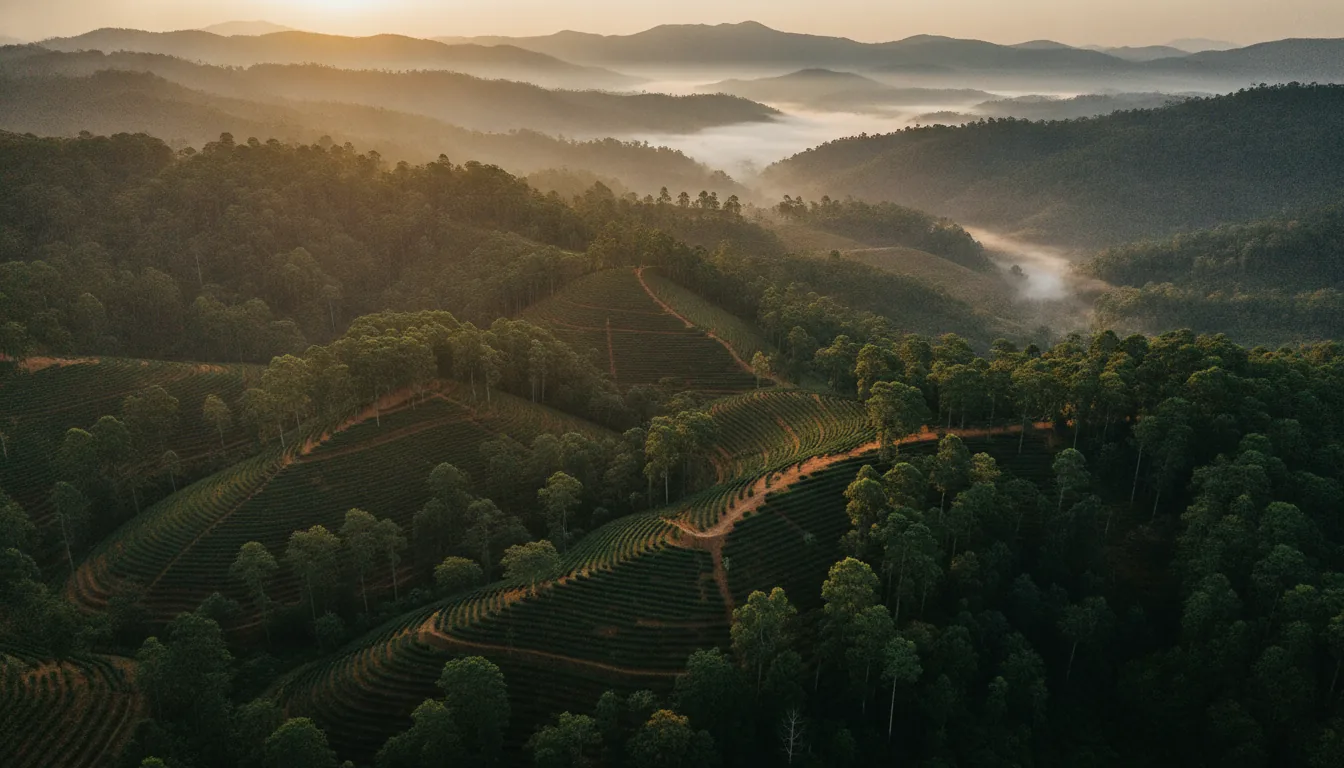
Ask where the land sits in real geography, not just a district name. Hassan district, which holds the Belur-Sakleshpur belt, sits on the central Western Ghats and forms the northern flank of the traditional Mysore coffee belt. Estates there run roughly 800 to 1,200 metres, a little lower on average than neighbouring Chikmagalur. Rainfall runs from about 1,500 mm on the eastern edges to over 2,500 mm around Sakleshpur, with a dry season from December through March that ends in blossom showers. Those bands give you a basis for comparing one belt against another instead of taking a seller’s word that the region is good.
Ask all of this before you book the car. The answers decide whether the visit is worth making, and the visit is where you test them.
How to check that the road, water and boundaries are real, not seasonal
Test them on the ground, not on paper. Drive the final approach yourself, ask whether a car reaches in monsoon, run the borewell motor and watch the output, ask people living nearby whether the stream is perennial, and walk at least two sides of the boundary.
On the road, ask what the last stretch is made of, whether two vehicles pass each other on it, whether it is a public road or a private one, and whether anyone’s permission is needed to use it. A private approach held together by a neighbour’s goodwill is a different asset from a public road.
On water, ask for the pond’s size, depth and current level, and ask specifically what it looks like at the end of summer. Ask whether a stream is perennial or seasonal and confirm the answer with people who live there rather than with the seller. Ask to see the spring source point and its flow line. Ask for the motor to be run while you stand there. Then follow the gravity lines, pipelines, tanks and storage points to the places they are meant to serve.
On boundaries, ask for survey stones or markers and walk to them. Check the fencing condition and whether the boundary line reads clearly on the ground. Look for a neighbour’s crop or structure sitting inside the line, and ask directly about pathway or water disputes. Encroachment is easier to see on a walk than in a document.
While you are there, ask what powers the estate: three-phase supply for pumps and irrigation, transformer or meter details and whether the transfer is clean, the pump house and pipeline network, the condition of the drying yard, and the state of labour quarters and store rooms.
Infrastructure tells you whether the estate can be worked. The plants tell you whether it has been.
What to ask about the health of the coffee, pepper and shade trees
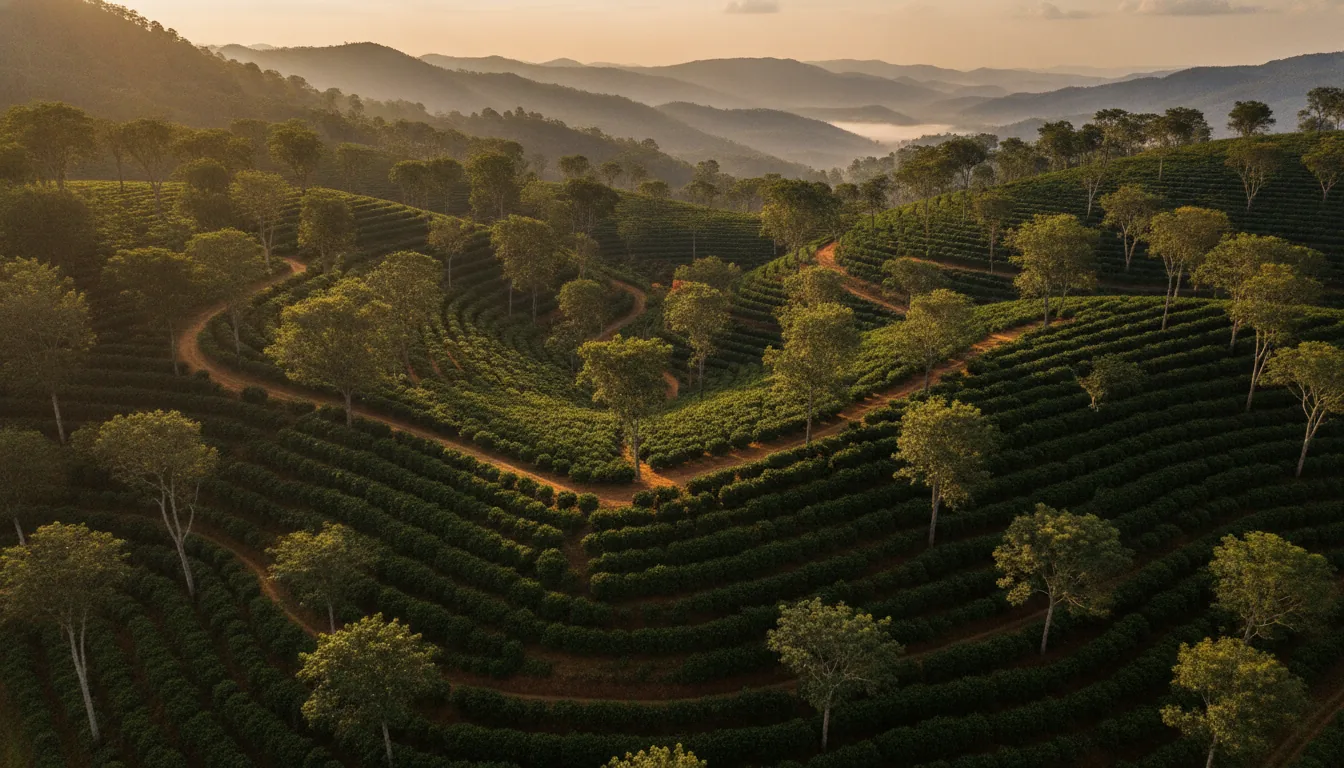
Ask which variety is planted and how old the plants are, how many gaps sit in the rows, how the shade canopy is built, how the pepper vines and their support trees are holding, and what the estate does about coffee white stem borer.
Variety first. Across Hassan district, Arabica and Robusta are grown in close to equal share, Arabica dominating above 1,000 metres and Robusta below it. S795 is the most common Arabica; CxR and S274 lead among the Robustas. A seller who knows the variety by name usually knows the block’s history too.
Then condition. Ask whether plants are developing or producing, count the gaps and missing plants, and read the leaves for yellowing, pest damage and drying branches. Ask when the estate was last pruned, how weeds are controlled, and whether the basins are kept clean. Ask about pepper vine health and the strength of the trees supporting the vines, the silver oak count and spacing, and the native jungle trees carrying the shade.
Shade is not decoration. Shade trees, predominantly silver oak and native forest species, are maintained on nearly all estates in the district, and how they are arranged bears directly on pest pressure.
Coffee white stem borer is the question most buyers skip. It has been recorded in India for close to a century and primarily threatens Arabica. It concentrates in hot spots: less shaded areas, rocky patches, and blocks with a western aspect. Once the larva is inside the coffee stem it is very hard to reach, which is why the meaningful work happens before that point. Documented preventive practice includes bark smoothening or polishing ahead of March and September, a 10 percent lime coating on stems and branches, and maintaining a two-tier mixed shade canopy, with infested plants traced and uprooted. An estate that can describe its own routine in those terms is being maintained. An estate that answers with reassurance is not.
Everything so far is visible on a walk. The next set is not, and it decides what you actually walk away owning.

Which documents to ask for, and what each one proves
Ask for the latest RTC or Pahani, the mutation extract, the encumbrance certificate and the survey sketch. Then ask what each one proves: the current record, how the land reached this seller, whether anything is charged against it, and where the boundaries legally sit.
The RTC, also called the Pahani, is the running land record for the survey number. It carries the holder’s name and the cultivation details, and it is the document your own name has to appear on after the sale.
The mutation extract records the transfer that placed the current seller on that record. It is the join between the previous owner and this one, and a missing join is a reason to stop rather than a detail to fix later.
The encumbrance certificate shows what is charged against the land: loans, liens and registered claims over a period. Ask for a period long enough to cover the seller’s whole holding, not a convenient window.
The survey sketch, read together with the survey numbers, is the legal shape of the land. Carry it on the boundary walk from the previous section and compare it against the stones on the ground.
Beyond those four, ask for the title flow documentation, the conversion status records, the bank loan and lien position, and the results of a litigation check. Then have your own lawyer read all of it. A seller who welcomes that is telling you something useful before you ask another question.
The document set proves the land’s history. The next question decides whose name that history continues under, and what you actually own when you buy an estate sets out the registration and records side in full.
How to confirm the land will be registered in your own name
Ask one question plainly: after registration, whose name appears on the land record? Then ask whether you are buying land or a position in a structure that owns land, and ask to see the draft sale deed and the record as it will read once the transfer completes.
Two different arrangements travel under the same word. In the first, you receive a registered piece of land, the land record carries your name, and the estate around it is worked under a management service. In the second, you receive a stake in an entity that holds the land, and the record carries the entity’s name rather than yours. Both exist openly in this market. Neither is readable from the word “managed” on its own, which is exactly why the question has to be asked out loud and answered in one sentence.
Our answer, since this checklist applies to us as well: you receive a half-acre of managed coffee estate registered in your own name, with your own land record. Half an acre is the minimum, and larger parcels are available.
Whose name goes on the record assumes you are allowed to be on it at all, and that is where a large number of buyers stop themselves without cause.
Whether you are even eligible to buy agricultural land in Karnataka
Yes, in almost every case. The Karnataka Land Reforms (Amendment) Ordinance 2020 repealed Sections 79A, 79B and 79C, which had restricted non-agriculturists from acquiring agricultural land. Any individual, trust, company, society or educational institution may now purchase agricultural land regardless of income.
The old belief outlived the old law, which is why this still stops otherwise-ready buyers. Before the amendment, purchases were screened on non-agricultural income and non-agriculturists were kept out; the income ceiling went out along with the sections that carried it. Section 80’s outright bar on selling agricultural land to non-agriculturists was lifted too, with restrictions now applying only to the transfer of certain categories of land.
Some things did not change. Section 81 stands, so agricultural land may be mortgaged only in favour of specified institutions. A new Section 80-A was added to preserve SC and ST land rights under the 1978 Act. So the question to put to a seller is not only whether you may buy, but which category this particular land falls into, because the remaining restrictions attach to categories of land rather than to buyers.
One case sits outside this page. NRIs cannot purchase agricultural land in India under FEMA, 1999, and may acquire it only by inheritance or gift. That subject has a page of its own: owning an estate in India as an NRI.
The limit on how much agricultural land one buyer can hold
Yes, there is one. The same 2020 amendment raised the ceiling from ten to twenty units for a single individual or a family without members. For families above five members, the ceiling is twenty units plus four additional units for each member beyond ten, up to a maximum of forty units.
A unit is a measure set by the Act rather than a flat acreage, so ask your lawyer to convert the ceiling into acres for the specific land in front of you before planning a second or third purchase. Most single buyers sit far below the ceiling. Buyers assembling a larger holding across several purchases need the number written down before they start.
Law and paperwork settle what you own. The next three questions settle what happens on the land after you own it.
What the managed service includes, and what it leaves out
Ask for the inclusions in writing, item by item. Acres Community defines managed as farming and crop care, security, roads, fencing and water, and a dedicated relationship manager for every owner. Ask any seller to state what sits outside that list, and who pays for it.
The exclusions are the part worth pressing on. Ask what the owner carries annually for labour, manure, pruning and spraying, whether those costs sit inside the service or are billed separately, and how changes are communicated. Ask how the arrangement is documented, what its term is, and what happens to the estate if the service ends. A seller who has thought the model through answers without improvising.
Ask what the service covers across the whole crop mix, too. A working estate here is coffee, pepper and timber together, and each has a different calendar. A service defined only around coffee leaves two of the three unattended for most of the year.
The day-to-day shape of what a managed estate actually includes is set out in full on the managed-estate hub. A written list is only as good as the person who answers the phone when something on it goes wrong.
Who your single point of contact is after you buy
Ask for a name and a role, not a department. Ask who tells you when something happens on your land, how you reach them between visits, and who answers if they are unavailable. Every owner here is assigned a dedicated relationship manager.
A managed purchase moves the work to someone else, which means information about your own land reaches you through a person. Ask how often you hear from them without having to ask, how a visit is arranged, and what the escalation path looks like when an answer does not arrive. Ask whether the same person handles estate operations and your paperwork, or whether those sit in different hands.
Ask what happens on a visit as well. You are visiting your own land, so ask about access, notice and what you can see while you are there.
What to ask about how the crop is handled
Ask who harvests, who processes, and what happens to the coffee, pepper and timber after picking. Then ask for records rather than projections: the estate’s own account of past harvests, the proof behind it such as bills or buyer details, and whether the estate has been maintained continuously.
Continuity is the real question buried in that. An estate left standing unmaintained for a few seasons looks similar from the road and behaves very differently for years afterwards. Ask when pruning last happened, how weed control has been kept up, and whether the basins have been maintained through that period.
Ask for the annual expense picture as the seller actually records it: labour, manure, pruning and spraying. You are not asking for a forecast. You are finding out whether the estate has been run by someone who keeps records at all, because a seller with records has a history and a seller without one has a story.
Records tell you how the estate has been treated so far. The last three questions are about the years after you sign.
Whether you can sell your land later, and on what terms
Ask before you buy, not after. Ask whether resale is possible at all, who has to approve it, whether anyone holds a first right of refusal, and where those terms are written. Our answer: an owner may sell their half-acre independently, and the company holds first right of refusal.
The shape of the answer follows the shape of the ownership. Where you hold a registered piece of land in your own name, resale is a land transaction you carry out, subject to the terms you agreed at purchase. Where you hold a position in an entity, exit follows that entity’s rules and its timetable. Ask which of the two describes what is on offer, and ask to read the clause rather than hear it summarised.
What happens to the land if something happens to you
Ask what your family actually inherits and in whose name it lands. Our answer: the half-acre passes to the owner’s family as land, not as a company share. Ask any seller to state the inheritance position in writing, and ask what the heirs then have to do.
Land and paper behave differently across a generation. Land that already carries your name on the record passes as land, and your family continues with the same document set you were handed at registration. A position in an entity passes according to that entity’s constitution, so the heirs inherit a relationship with the entity rather than a piece of ground.
Ask, in the same conversation, what the management service does during a transition, because the estate keeps growing while the paperwork catches up.
What to ask if a seller quotes you a return figure
Ask what the figure is based on, over what period, and whether it is contractual or indicative. Returns on a living crop depend on weather, pest pressure and market price, so a projection with no stated basis is an opinion rather than a commitment.
Push on the assumptions underneath it. What price is the crop assumed to fetch. What is the assumed harvest built on. What happens to the number in a bad year. Will the seller write it into the agreement, and what is your recourse if it is not met. Those questions settle the matter quickly, because a figure that is meant seriously survives them and a figure that is decoration does not.
We do not publish return figures. What we describe is the land, the registration in your name, and the service that keeps the estate worked.
That is the checklist. What follows is the short version of the questions buyers ask most often.
Frequently asked questions
How to buy a coffee estate?
Shortlist by belt and elevation, ask the pre-visit questions before you travel, then visit and test road, water, boundaries and plant health on the ground. Collect the RTC or Pahani, mutation extract, encumbrance certificate and survey sketch, have your own lawyer read them, and register the sale deed in your own name. If the estate is managed, get the service inclusions in writing before you sign anything.
What questions to ask when buying land?
Start with three: whose name appears on the land record after registration, which documents you will receive, and what the seller commits to doing on the land afterwards. Then work through the pre-visit set, the document set and the management set above. The checklist at the top of this page doubles as the list to carry with you.
Are coffee estates profitable?
That depends on weather, pest pressure and the market price of the crop in a given year, none of which any seller controls. Treat a quoted figure as a claim to be tested: ask what it is based on, over what period, and whether it is contractual. A projection that cannot answer those three questions is not a basis for a purchase decision.
Do I get the land registered in my own name?
Ask this of every seller, because the answer varies across offers that use the same words. Here, a buyer receives a half-acre of managed coffee estate registered in their own name, with their own land record, half an acre being the minimum and larger parcels available. Where an offer instead gives you a position in an entity that holds the land, the record carries the entity’s name.
What is included in the management service?
Farming and crop care, security, roads, fencing and water, and a dedicated relationship manager for each owner. Ask any seller for the same list in writing, with the exclusions named and the recurring costs identified. The crop mix matters too, since coffee, pepper and timber are worked as one estate on a single calendar.
Can I sell my land later or pass it to my family?
Yes on both counts. An owner may sell their half-acre independently, with the company holding first right of refusal, and the half-acre passes to the owner’s family as land rather than as a company share. Confirm both positions in writing before you buy, whoever you are buying from.
Take the list with you
Print it, screenshot it, or read it off your phone at the gate. A seller who answers all thirteen without hesitating has nothing to hide, and one who cannot has told you what you needed to know.
If you want the ownership side in more detail, the ownership and documentation side in full covers registration and land records properly, and how the management service works day to day covers what the coffee estate team does through the year. To apply the checklist to something real, the one estate currently open at Belur-Sakleshpur is the live Acres Community project, a managed coffee, pepper and timber estate where each buyer’s half-acre is registered in their own name.
Ask us the thirteen questions and we will answer them in the same order. For availability and current pricing, enquire and we will take you through it.